The powerful properties of hibiscus tea
Looking for more plant power in your life?
Hibiscus tea is as beautiful as it is powerful. High in antioxidants with well documented health benefits, it also tastes wonderful hot or cold and looks gorgeous, too. It may be a perfect drink.
Deep pink and gloriously tart, humans have been savoring hibiscus for centuries for both medicinal purposes and pure enjoyment.
Turns out, it’s kind of a wonder drink.
The ancients already knew all about it. As early as 3000 BCE we know that the people of the Nile Valley were drinking hibiscus infusions hot and cold and using it in rituals and healing practices. But it wasn’t until the 16th century that the drink became well documented and began spreading throughout global trade routes for its taste, color and powerful plant medicine.
The medicinal uses of hibiscus leaves
Thanks to ancient Egyptians and the Ebers Papyrus, we know that hibiscus leaves were used medicinally since at least 1550 BCE. Written in hieroglyph, the scroll documents 700 medical formulas then in use—hibiscus among them!
Ancient people have also documented the leaf’s use through thousands of years of oral tradition, telling of uses in both teas and topical ointments for a wide-ranging set of ailments, from skin issues to heart problems.
Centuries later, in late 15OOs, Flemish botanist Matthias de l’Obel began documenting from the oral traditions the known medicinal uses of hibiscus.
Modern clinical studies of hibiscus
Though the oldest documentation of hibiscus happened more than 1500 years before the common area and Matthias de l’Obel’s came another 3000 years later, we had nearly 500 more years to wait for modern science to catch up to what ancient peoples had already known.
By the late 1990s, clinical studies of hibiscus were on the rise and by 2008, a major study done at Tufts University put hibiscus on the modern scientific map as a plant with significant, measurable benefits for cardiovascular health.
Not all hibiscus varieties are the same: Hibiscus sabdariffa
The specific variety of hibiscus used to make hibiscus tea is Hibiscus sabdariffa, commonly referred to as “roselle” in many places.
While some species of hibiscus are native to north America, hibiscus sabdariffa is not one of them. It originated in central and west Africa. The climate of parts of the southern U.S. a well suited to growing the roselle variety of hibiscus and the plant is now well established in many hotter and drier regions, globally.
What is hibiscus tea?
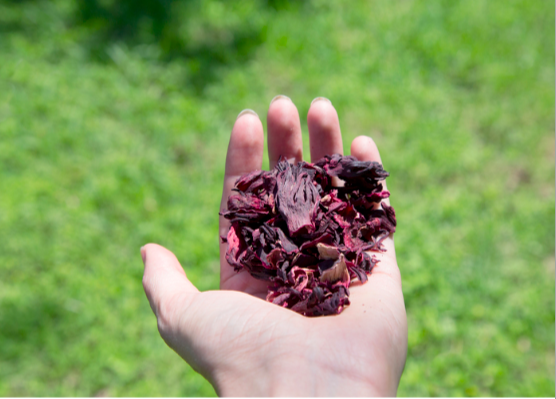
Hibiscus tea is simply the dried leaves of the roselle variety of hibiscus flowers steeped in hot water to extract its flavor. It creates a bright pink and tart brew on on its own that many find refreshing as is. It’s often blended with other plants, liquids and sweeteners to create a range of hot and cold drinks.
Hibiscus is herbal and not caffeinated on its own. When it’s not mixed with other tea leaves, it’s technically an herbal brew or “tisane,” though these are still widely and informally called “tea.”
Of course, you can mix dried hibiscus leaves with dried tea leaves to make your tea.
Documented health benefits of hibiscus tea
High in antioxidants.
Many clinical tests have shown what ancient medicine has documented for centuries: dried hibiscus leaves are high in antioxidants.
Studies have shown that “in a comparison of the antioxidant content of 280 common beverages, hibiscus tea ranked number-one, even beating out the oft-lauded green tea. Within an hour of consumption, the antioxidant power of your bloodstream shoots up as the tea’s antioxidant phytonutrients are absorbed into your system.” (source)
Lowers blood pressure and cholesterol
According to the National Library of Medicine, studies show that hibiscus tea can significantly and positively affect cholesterol of people who have diabetes. Other studies suggest that the positive changes to cholesterol likely extend to those with elevated cholesterol who don’t have diabetes.
In addition, drinking hibiscus tea has been shown to lower blood pressure. While some studies say that it might not be enough for some folks, still requiring medication, other studies show effects similar to medication for early-stage hypertension.
Where to buy hibiscus tea leaves
The good news is that dried hibiscus leaves are typically easy to find, both online and at many regular grocery stores. Search for dried hibiscus leaves or check other common names: sorrel and Flor de Jamaica.
Locally, check your favorite grocery store in both the tea section and in the international sections. Or try an international market if you have one nearby. Middle eastern, Mediterranean and Hispanic or Mexican markets commonly sell dried hibiscus.
How to make your own hibiscus tea
There are many, many recipes for hibiscus teas, both hot and cold. The basic recipe is to steep dried leaves in boiling water, strain and sweeten.
How long you steep will depend on the amount of tea you’re making and the strength you want. Start with 1-2 tablespoons of leaves per 8 ounce cup and steep for 5 minutes. For a larger batch of iced tea, use up to 1 cup of leaves and steep for 20 minutes in 4 cups of water to make a concentrate. Then strain, sweeten to taste and dilute with cold water.
We like to blend hibiscus leaves with tea leaves for an afternoon boost. Check out our recipes for Hibiscus Pick-me-up Tea.