The happy hours
Around the world, people bridge the space between work and home with food, drink, and community.
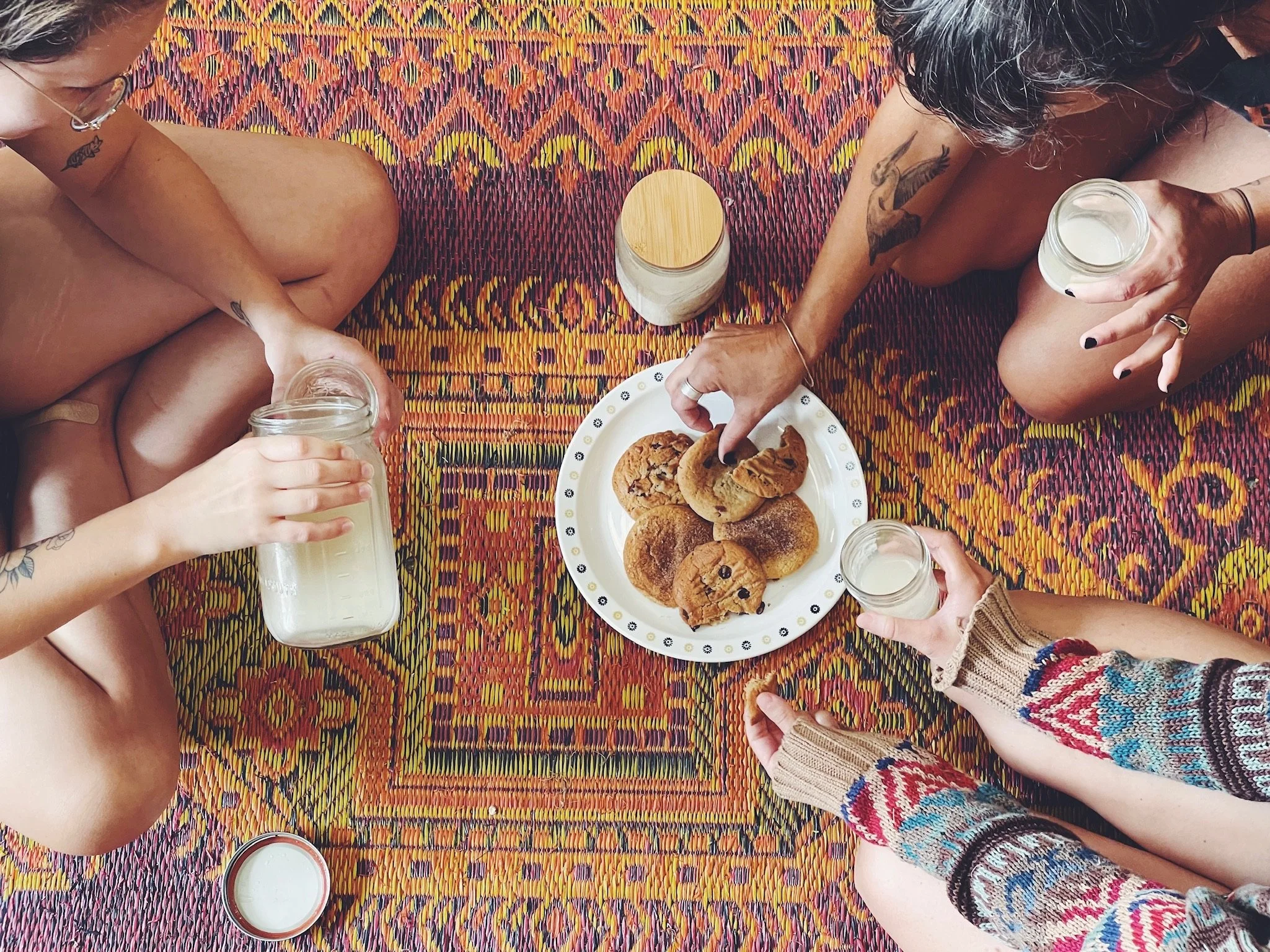
How about a milk and cookie happy hour?
In Sweden, it’s called fika. In Japan, nomikai. In Spain, tapas. In Italy, aperitivo. In the United States, it’s known as happy hour. The details vary: there may be tea or coffee or wine or spirits; cakes or cookies or olives and cheese. Some gatherings are boisterous, others quiet. Some happen in cafés, some in bars, some in living rooms or courtyards or break rooms.
There’s no single formula—but there is a key ingredient: community.
Across cultures and continents, people have independently developed daily rituals that mark the end of the workday and the beginning of shared time. These moments serve as a threshold, a space that allows us to set down our to-do lists and step into community—with friends, coworkers, and neighbors. It’s more than a fun break—it’s social glue.
Why happy hours matter
We humans are social beings. Work may structure our weekdays, but community gives them meaning. And it can be hard to transition from our roles defined by output to our roles defined by connection.
Anthropologists and sociologists have long noted that informal gatherings play a crucial role in social cohesion. Unlike formal meetings or planned events, happy-hour-style rituals are low-stakes and recurring. You don’t need a special reason to attend. You don’t need to perform. You simply show up.
In this way, once weak ties—with acquaintances, coworkers, neighbors—become stronger. We share ideas, vent frustrations, share news, and laugh together.
That these practices emerged independently around the globe is no accident. Happy hours meet a universal human need to connect and belong while unwinding the stresses of worklife and creating a more joyful and centered space for family and community.
The decline of the daily gathering
In many places, happy hour rituals have been quietly eroding. The reasons are many:
Association with alcohol: In some places, including the U.S., happy hour emphasizes drinking alcohol, making it a hard sell for people who avoid alcohol for any reason. When alcohol becomes the point rather than a possible accompaniment, the community aspect suffers.
Economics: The rising costs of living and tighter budgets mean fewer people can spend money on daily outings. What was once a modest, routine indulgence can start to feel like an unnecessary expense. At the same time, small, locally owned cafés and bars—the natural homes of these rituals—are disappearing under the pressure of their own higher costs.
Remote work: While remote and hybrid work have brought flexibility and autonomy, they’ve also reduced casual, in-person interaction. Without a shared physical workplace, there’s no natural moment when everyone stands up and says, “Shall we grab something?” The workday stretches, blurs, and bleeds into community time.
Fewer “third places”: Third places—places that are neither home nor work but are accessible, welcoming, and designed for lingering—are also on the decline. Libraries are online, small community stores close as larger stores take over, and fewer people use community centers as local information hubs. As cities become more expensive and efficiency-driven, fewer spaces invite people to simply be together without an agenda.
Reclaiming daily community time
These rituals matter more than we might think. In an increasingly online—but disconnected— world, daily community time is not a luxury—it’s a necessity.
Reclaiming happy hour doesn’t mean recreating the past exactly as it was, nor does it require alcohol or expense. It means intentionally carving out shared time and shared space at the end of the day.
It might look like a standing coffee or tea break, a weekly neighborhood meetup, a walk with coworkers at the end of the work day, or a game evening at the local library. Or yes, it could mean a cup of coffee or tea or a glass of wine with snacks at your favorite local spot.
The key is to connect. By saying yes to one more conversation. By lingering instead of rushing. By showing up consistently—even for 20 minutes—to build something larger than the moment itself.
Creating community, together
These rituals—happy hour, fika, aperitivo and the many other afternoon gatherings around the globe—help create the community cohesion and trust we need to sustain us through hard times and celebrate the good times.
They keep us practicing the skill of seeing from other perspectives, of listening, of coexisting with difference. They remind us that we are part of something beyond our own to-do lists.
They allow us to co-create the community we want to live in.
Happy hour, in all its global forms, is not about escaping life. It’s about entering it more fully—together.