Coffeeconomics: The costs & benefits of coffee at home
Whether you’ve perfected your at-home brew setup or you’ve got a hand-me-down Mr. Coffee, brewing at home is less expensive and better for the environment. That doesn't mean you should give up your favorite coffee shops. Here’s how to decide which to choose.
Whether you’ve perfected your at-home brew setup or you’ve got a hand-me-down Mr. Coffee, brewing at home is less expensive and better for the environment. That doesn't mean you should give up your favorite coffee shops. Here’s how to decide which to choose.

Without a doubt and by a long shot, making your own coffee at home will save money, time and trash. When you add together the time it takes to get to the shop, the resources that went into getting there, the money you spend and how much trash the whole experience produces, it’s difficult to come to any other conclusion.
We haven’t given up on coffee shops though.
According to multiple sources, “Independent coffee shops bring in more than $12 billion in annual sales” (1) and a large chain like Starbucks brings in even more—around $25 billion in sales. Together, we spend at least $37 billion at coffee shops every year.
The thing is—we aren’t always at home when we’re craving a coffee. And even if we were, coffee shops can have a lot to offer—jobs, community, vibe, Wi-Fi, and a reason to leave the house when you work from home. And maybe that’s worth a collective few billion dollars.
So let’s take a look at the costs and benefits of coffee from home and coffee away.
Adding up the dollars
Let’s put an actual dollar amount on the issue. Here’s what you’ll spend on a simple coffee with milk and a little sugar (café au lait if you like), made with high quality, organic coffee and oat milk.
At the local shop
We priced this drink at several coffee shops in cities across the country and came up with an average price of $2.50, not including a tip. We hope you tip at least 20 percent, so we’re going to round this one up to $3.00.
$3.00 for a café au lait at the local shop
Coffee at home
To price your at-home coffee, we’re including the cost of your brew method (CoffeeSock!). That’s about four cents per use, assuming a pack of filters will last about a year of daily use. If you’re making more than one cup at a time, you can divide that $0.04 even further by the number of cups you make.
$0.04 for your CoffeeSock
The most expensive element of coffee at home is the coffee itself. We’re being very generous here at grabbing a bag of high end organic and fair trade beans, which is $16 for a 12 oz bag. That’s about $20 for a pound, which makes 32 cups. If you’re buying from your local grocer, you’ll probably spend less.
$0.50 to $0.63 for the beans—$0.57 average.
Oat milks range in price and quality by quite a lot. Going for a mid-range average, let’s call it $3.00 for 32 ounces. For a traditional cafe au lait, you’ll use about 4 ounces of milk, for a grand total of 38 cents.
$0.38 for 4 oz of oat milk
Finally, we get to the sugar. The range here varies by a lot depending on the type of sweetener you use and the amount. For about a tsp of sugar per 8 ounce cup of coffee, you’re looking at about 3 cents, on average.
$0.03 for a tsp of sugar
The total? $1.38 for a high-quality, organic 8 ounce café au lait made at home. Assuming a $3.00 comparison drink, and not including any gas or other resources you spend going to the shop, you’ll save a minimum of $1.62 per cup, or about $500 a year if you make the swap most days of the year. Use a less expensive coffee and skip the milk, and savings jump even higher, up to $1000 year for only one cup at home most days.
The environmental savings
We’ve written A LOT about the environmental price of the single-use cups, lids, straws and other disposables. It’s truly an environmental nightmare. Of course, you can bring your own cup to the shop or stay and sip, using a washable cup. In fact, ordering “for here” has several benefits we’ll discuss below.
The disposables aren't the only environmental issues.
Studies show that at coffee shops and kiosks with drive throughs, a large portion of people use it. Ordering from a drive through means gas, idling, and yes, disposable cups, lids and straws.
Many coffee shops also brew large amounts of coffee for quick services, but if it doesn’t get used by the time it hits peak freshness, it gets thrown out. And that waste contributes to depleted coffee resources, overfarming, and price increases.
So, when should you choose a coffee shop?
We love our local coffee shops dearly. We love seeing the familiar faces who work there and the connections we make with them. The best cafes have that special vibe when you walk in—welcoming, warm, friendly.
At community-centered cafes, people meet to chat, do business, catch up, and enjoy each other’s company. Local artists display their work and community members hang signs advertising gigs, roommates wanted, sofas for sale, fun events and fundraisers. You can read a local newspaper or settle in with a book.
A coffee shop can be a magical place. And when you’re out and about and in need of a cuppa, you don’t need to go home to make it.
Here’s our short list of when we choose a coffee shop:
We’re closer to a local shop than we are to our home.
We’re at home and really need to get out of the house and clear our heads.
We have time to sit and stay awhile, enjoying the space that a shop creates.
We want a vibey place to meet a friend, client or coworker.
We want to support a community-embedded space.
We have a poster to hang on the wall.
The bottom line? Make your coffee at home when you can, your wallet and the environment will thank you. Save the shop for those times when only the local shop will do the magic. In other words, choose shop-bought coffee with intention. And bring your own cup!
What are microplastics? And how did they get in our water?
Plastic makes up the majority of trash found in lakes, oceans and rivers. Over time, plastic breaks down into smaller and smaller molecules until they become microplastics, a tiny menace. Here’s the scoop on microplastics and what you can do about them.
Plastic makes up the majority of trash found in lakes, oceans and rivers. Over time, plastic breaks down into smaller and smaller molecules until they become microplastics, a tiny menace.

Microplastics are pieces of plastic that measure 5 millimeters or smaller. That’s about at long as the tip of a sharp pencil. In fact, a typical pencil eraser is about 5mm all around. So, if a piece of plastic is smaller than that, it’s a microplastic.
But so what?
As scientists study the effects of these small pieces of plastic, they are finding just what you would expect—microplastics are bad for ocean life, which should be enough evidence against them. They likely have a directly negative effect on humans too.
Where do microplastics come from?
Some plastics were designed to be tiny and others become tiny when they break down. So, there are two types of microplastics: primary and secondary.
The primary type is tiny by design. If you’ve ever used a face wash that contains tiny exfoliators, then you have an idea what this type of microplastic looks like. In fact, prior to 2015, many exfoliating beauty products contained these plastics until the U.S. banned microplastics in beauty products.
The secondary type of microplastics come from larger plastic items—bottles, beads, cups, caps and the rest. When these items find their way into waterways, they eventually break down into smaller and smaller pieces.
The National Oceanic and Atmospheric Administration breaks it down for us:
Most plastics in the ocean break up into very small particles. These small plastic bits are called "microplastics." Other plastics are intentionally designed to be small. They're called microbeads and are used in many health and beauty products. They pass unchanged through waterways into the ocean. Aquatic life and birds can mistake microplastics for food.
How do microplastics end up in the water?
We’ve written before that much of the trash found in waterways is plastic. It gets there when people litter in or near water sources, such as fish nets that stay in the water or water bottles left on the beach.
Litter left anywhere can end up in the water too when it gets swept away by wind and rain or when wastewater runs into the ocean through sewer systems and overflows.
Are microplastics dangerous?
If you’re a sea turtle, fish or ocean bird, the answer is almost certainly yes. For humans, scientists have just started to research the short- and long-term effects of ingesting plastic.
According to National Geographic:
Microplastics have been detected in marine organisms from plankton to whales, in commercial seafood, and even in drinking water. Alarmingly, standard water treatment facilities cannot remove all traces of microplastics. To further complicate matters, microplastics in the ocean can bind with other harmful chemicals before being ingested by marine organisms.
For humans, we definitely eat and drink microplastics. Statistica tells us that “The average person eats, drinks and breathes between 74,000 and 114,000 microplastic particles every year - and that is considered an underestimate.”
Not all plastics are considered equal—the quality and chemical makeup varies widely. Some contain chemicals that break down readily and enter our body and others probably come out without much breakdown in the same way all other waste exits our system.
Turning again to NatGeo:
In laboratory tests, microplastics have been shown to cause damage to human cells, including both allergic reactions and cell death. But so far there have been no epidemiologic studies documenting, in a large group of people, a connection between exposure to microplastics and impacts on health.
If we know that plastics are harmful to sea life and cause problems—no matter how large—for humans, then we know we should take action.
What can we do to reduce microplastics?
What can we do about it? This is both the simplest and hardest question to answer.
The simple answer? We must severely reduce our use of plastic, if not eliminate it. We now have many alternatives to plastic, especially single-use plastic, including bioplastics made from organic material.
The not-so-simple truth? Plastics are everywhere, and individual humans like you and I share only part of the blame. I’m sure you can guess who makes all and uses most of the plastic—big corporations.
Still, there’s plenty we can do. If we simply limit single-use plastics, we can make a big difference. Globally, we use 130 million tons of single-use plastic and, by design, we throw it away.
In 2021, the New York Times reported that “The average American uses and throws away 110 pounds, or roughly 50 kilograms, of single-use plastic every year. Only Australians currently match American scales of waste.” And at the time of this report (just last year), “Only about 8 percent of plastic gets recycled in the United States.”
Inventory your plastic use
Take a walk around your house looking for plastic. Jot them down on paper, snap pictures with your phone or make a voice recording.
Go room by room looking for all of the visible plastic. The flower pots in the window, the reusable containers in the fridge and pantry, the board game pieces, the picture frames—all of it. Then sit and contemplate your list.
For some people, plastic items are life savers. Sometimes literally. If that includes you or someone you love, then please count those plastics that help you as the absolute best reason to preserve the use of plastics. Those products that make life livable for people who would have struggled before—those are plastics living their best lives. We’re here for that.
So, we’re not going to get rid of every single plastic item. And that’s not the goal anyway. We;re suggesting that you look for the most easily avoided and simple-to-replace items on your list and start there. Swap them out one by one, over time. And when it’s time to get rid of a plastic, ensure it gets recycled if you can.
Because those water bottles now will become tiny plastic particles later. And instead of drinking from them, you’ll be drinking the plastic itself.
It's time to swap out your paper towels
The U.S. leads the world in paper towel use. And while a single paper towel doesn’t have much impact on the planet, when you add us all up, paper towels are a big problem. Whether you use paper towels regularly or only break them out for parties and spills—the Swedish dish towel will come in handy. A cloth/paper hybrid, it can take on the messes without all the waste.
Whether you use paper towels regularly or only break them out for parties and spills—the Swedish dish towel will come in handy. A cloth/paper hybrid, it can take on the messes without all the waste.
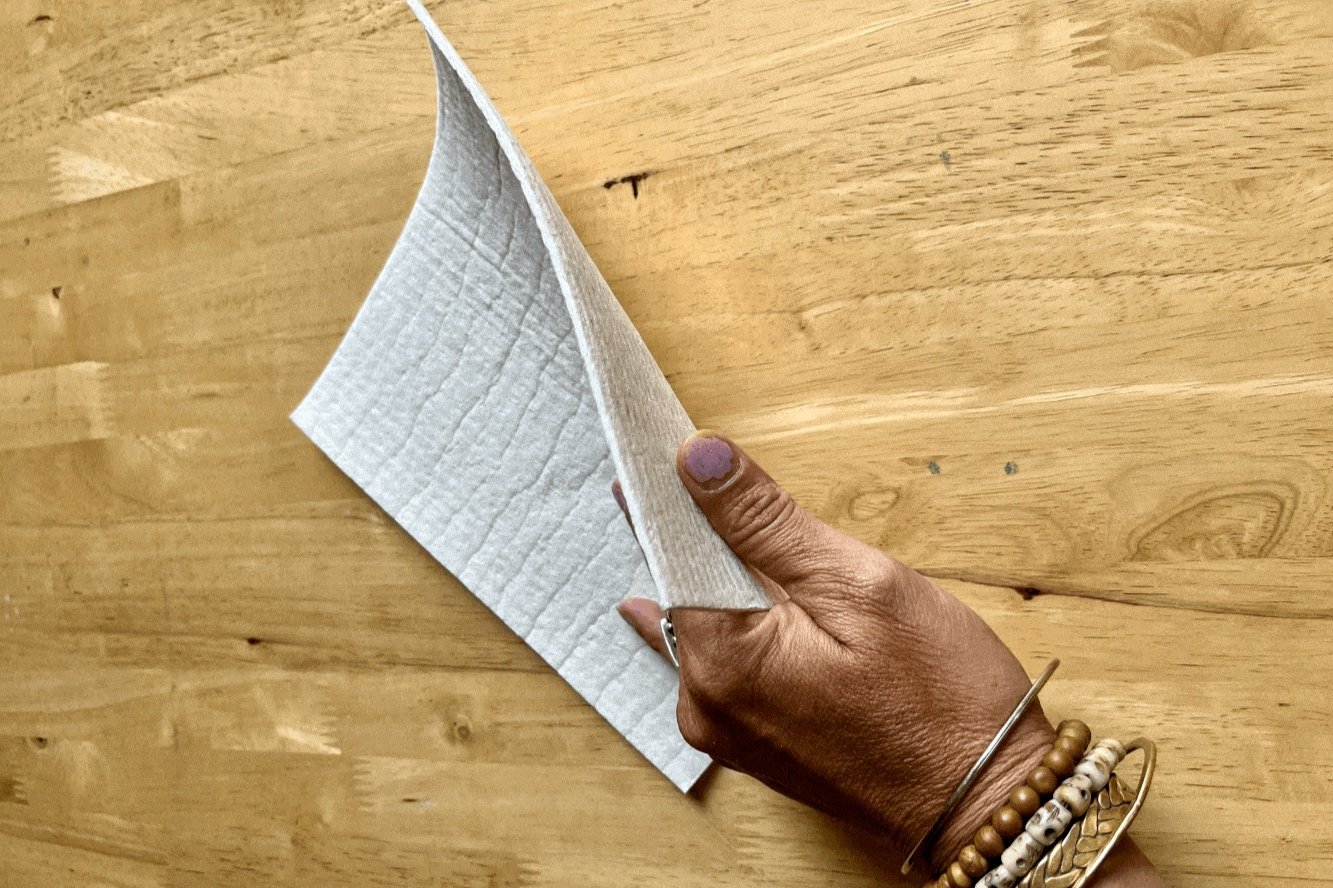
Even as the U.S. spends more each year on environmentally friendly goods, we still lead the world in use of paper towels.
According to a 2018 article in The Atlantic, “the U.S. spends nearly as much on paper towels as every other country in the world combined.” And it isn’t just because we have a larger population than many countries. We spend more on paper towels as a whole, and also as individuals.
The U.S. “stands apart on a per capita basis as well. In 2017, the average American spent $17.50 on paper towels. The closest competition on this measure comes from Western and northern Europe, led by Norway at $11.70 per person.”
Of course, that was four years ago. Where do we stand now? The short answer is that we now use more paper towels than in 2018.
Aren’t paper towels compostable?
You might be wondering why this matters. Paper towels are usually compostable and some brands are made with recycled paper. So, doesn’t that make them OK to use?
It’s true that a single paper towel contributes very little to overall environmental decline. It’s also true that the trouble isn’t with an individual paper towel, but with the use of paper towels in the aggregate.
In other words, our collective use of paper towels adds up to a serious environmental problem.
A few facts:
Many paper towels are bleached or colored with chemicals. So, while they are compostable, we don’t want those chemicals in our compost or water supply.
Being compostable does not mean zero waste on its own. Most people do not place used paper towels in compost bins, so they add to landfills where they do compost, eventually.
You can’t recycle a used paper towel back into more paper. So, the resource is not renewable. It requires trees to make more paper towels.
Production of all types of paper requires large amounts of water.
According to the EPA, “Tissue paper and towels (not including bathroom tissue) amounted to 3.8 million tons of waste in 2018.
The bottom line? We use a lot of paper products in our houses, and it takes tons of trees, water, chemicals and more to make, ship, sell and manage their waste.
Paper towels, why can’t we quit you?
Our paper towel habit likely boils down to habit, similar to our plastic bag habit before they were banned or shunned in many cities.
And there’s no denying the convenience of paper towels when it comes to cleaning day, the grossest spills, parties and campouts. Just as most of us became accustomed to reusable grocery bags, we can make the switch away from paper towels.
Here’s the good news—if we just started by cutting our use in half, we’d make a huge difference.
A middle ground swap—the Swedish dishcloth
You might not be ready to go 100 percent paper towel free. We get that. We’ve got a roll stashed around our house too, just in case. As anyone knows who has children, dogs or clumsy people around, some messes beg for the most absorbent and easy to clean (or toss) process.
Enter the Swedish dish cloth. They’re made with an absorbent combination of cellulose and cotton that rivals the spill-cleaning power of the best paper towels. They’re reusable, biodegradable and easy to clean. Just wash them off in warm water for minor cleanup, toss them in the laundry for a deep clean, or boil them to get them back to new.
What makes them “Swedish”? They were invented by a Swedish engineer in the 1940s and have been popular in Sweden and neighboring countries for decades. It looks like the U.S may be starting to catch on.
We’re here for it!
Focusing on the trash that comes with food
You might be surprised to hear that some disposable food packaging is better for the environment than unpackaged food. Not all food trash is equal. Here’s where you can focus for the greatest environmental impact.
You might be surprised to hear that some disposable food packaging is better for the environment than unpackaged food. Not all food trash is equal. Here’s where you can focus for the greatest environmental impact.
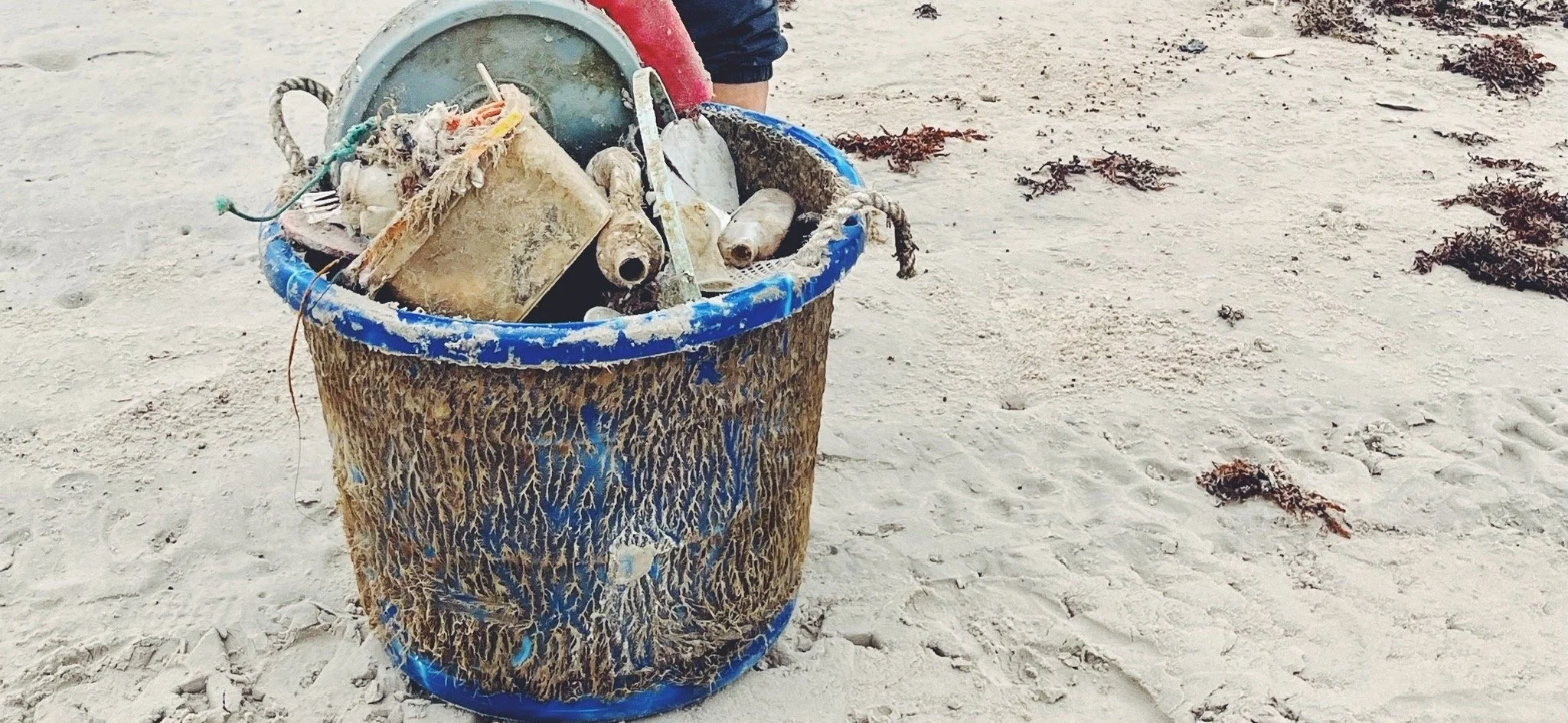
I recently went down a bit of a rabbit hole reading articles by Dr. Hannah Ritchie, the lead data scientist at Our World in Data. Her articles focus on the impacts of the world’s food systems on the environment. And some of her conclusions may surprise you.
For example, though we often hear the advice to “eat local,” research shows that, on average, what you eat is more important than how far it travels. Why? Because some types of farming cause more greenhouse emissions than transporting the food.
Another surprise? Some food trash, especially in the form of packaging, prolongs shelf life and prevents food waste while providing food for more people. It means we can transport farmed foods, reducing the total number of environmentally intensive farms.
Of course, not all food trash is equal. And research also shows that some types of food trash do cause more problems than solutions.
Here are three types of food trash to eliminate for more impact.
The trash that leads to deforestation
According to Dr. Ritchie, “Since the turn of the millennium, the world has been losing around 5 million hectares of forest every year. Nearly all of this occurs in the tropics; almost half of all deforestation takes place in Brazil and Indonesia.” (Source)
And what causes this massive loss?
“Beef production is responsible for 41% of deforestation; palm oil and soybeans account for another 18%; and logging for paper and wood across the tropics, another 13%. These industries are also dominant in a few key countries.”
Since this blog is focused on the trash that comes with food, I’ll focus here on the implications for food packaging and the disposable items we use to prepare our food and beverages. And I’m specifically looking at paper.
From paper plates and cooking supplies to paper coffee filters (CoffeeSock’s personal villain) and cups—where possible, we can avoid them. Where they already exist, we can recycle them.
The trash that ends up in rivers and oceans
Seven of the ten most common items found in the world’s rivers and oceans come from food waste. And I’m not including the 7.6 percent of trash that comes from fishing.
Rope, fishing gear and industrial packaging make up 18.9 percent of trash in the water, compared to 43.1 percent that comes from plastic bottles, food containers, plastic cutlery, lids, glass bottles and cans. Then there’s bags—making up a whopping 14.1 percent of trash in the water.
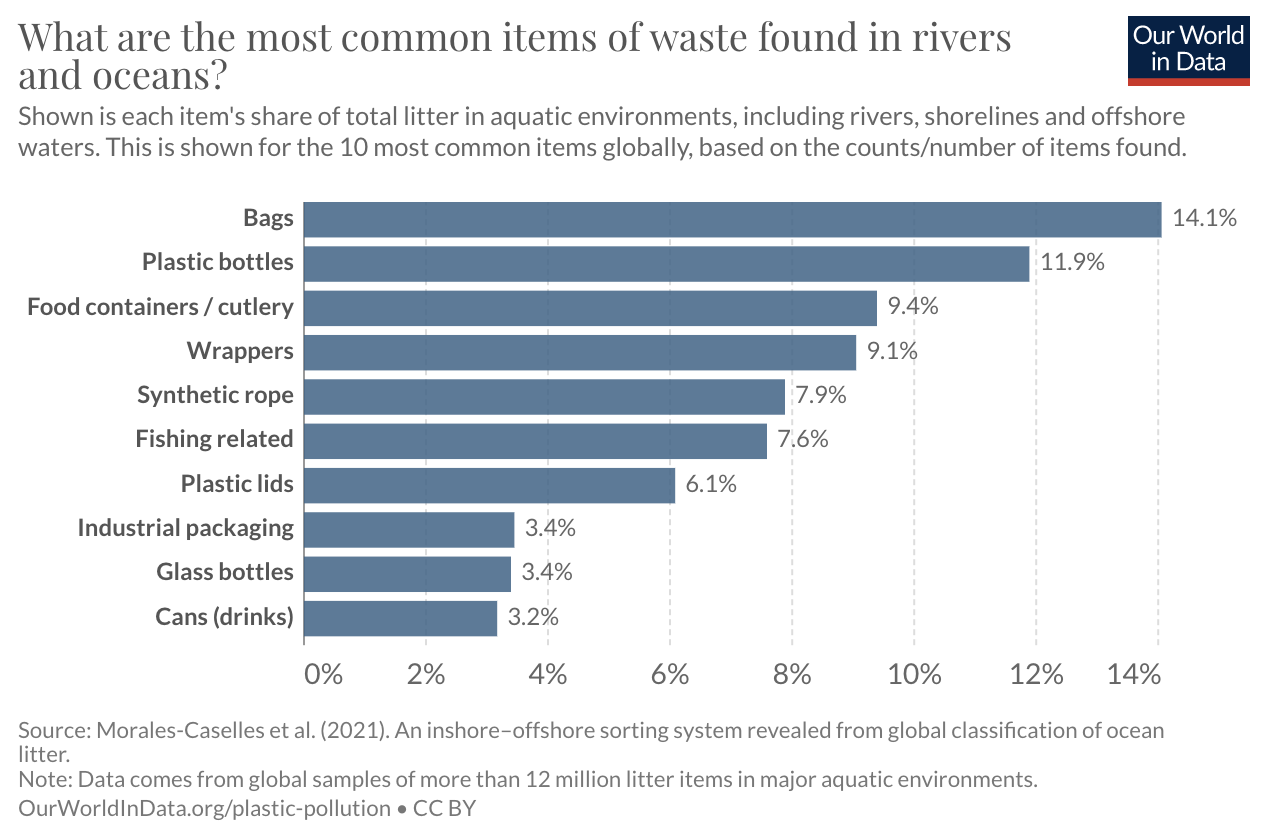
What can we do with this information? As Dr. Ritchie points out, some of this food packaging has less impact when it comes to preserving shelf life and keeping the whole food items out of the trash.
For you and me? It means focusing on eliminating the trash that doesn’t promote shelf life—that includes all plastic utensils, plastic cups with their lids, and plastic bottles where possible.
The trash from beverages other than water
In the case of both deforestation and trash in the water, we see that the paper and plastic we use for beverages comes up again and again in the forms of bottles, cans, and cups.
Also telling is the information that certain beverages: cow’s milk and (eeek) coffee, can be environmentally intensive to grow and distribute.
I was surprised to learn that coffee is unique in that the packaging used in the industry accounts for a larger portion of its overall emissions than for almost any other food or beverage. (Check out the chart on this page.) While the packaging is less of an issue than the farming itself, it’s still significant.
If you’re a big coffee fan (that’s why you’re here, right?), then it’s worth it to look into the packaging associated with your favorite brand.
In terms of milk, the article points out that dairy milk “has significantly higher emissions than plant-based milk.” We also see that nuts are at the bottom of the emissions list, in part because growing many nuts means growing trees.
That’s nut milk 2, cow’s milk 1. And to rack the points up higher, you can make your own nut milk to completely eliminate the plastic or glass containers that you purchase the milk in.
A short action plan for less food trash
OK. I just hit you with a lot of data. What should you actually do? Of course, that will depend on your personal preferences and lifestyle.
Because we believe in simple and economical solutions, here’s what we suggest:
Ditch paper coffee and tea filters (of course!)
Carry reusable food and beverage containers and cutlery with you when you can
To nourish body, soul and planet, add more luxury to your life
We rush around so frequently that nourishing ourselves feels more like a chore that happens on the way to some other event. What if we’ve got it all wrong? Luxury is ease, abundance, comfort and pleasure—and it can come from simple and nourishing places. Here’s how you can add more luxury to your life—and how it’s better for the planet, too.
Luxury is ease, abundance, comfort and pleasure—and it can come from simple and nourishing places. Here’s how more luxury is better for you and the planet.

We rush around so frequently that nourishing ourselves feels more like a chore that happens on the way to some other event. Maybe we order coffee at a drive through and drink it on the way to work, or pre-prep a wrap so it’s ready to eat during a busy working lunch.
We often frame those most essential parts of our lives as necessities in need of convenience. We seek to minimize time spent cooking, cleaning, grooming, dressing and exercising. And what does this leave us more time to do exactly?
What if we flip the script? What if we spend our time focusing on the art of those things we actually need to live? What if we frame necessities as spaces of luxury and seek conveniences elsewhere?
And the cool thing? When we inject luxury into the necessary daily acts of living, the planet benefits too!
Here are 2 ways to nourish your body, soul and planet.
Luxurious mornings
Coffee and tea are two of life’s simple pleasures, and perfecting your cup can be a fun, simple and sustainable way to enjoy the craft of a simple brew.
We’ve written before about the healing power of slow coffee. All it takes to inject luxury into your morning caffeine is your five senses.
To anchor in your senses brings you out of the jammed space of your head, out of the past and away from the future, and back into real life now. It’s a transformative habit, this pause. It offers clarity, calm, and healing. There are many ways to experience this. By far one of our favorites is the ritual of slow morning coffee. It’s a daily act of self care that costs little money and requires no special tools. When the world feels overwhelming, it provides 10 daily minutes of calm.
To bump up the luxury factor
Any store-bought coffee will work for this daily ritual. Of course, coffee from your local roaster is a good way to experiment with different flavors, roasts and smells. And even a more expensive bag of $15 beans comes out to .50 cents per cup.
How it helps the planet
Coffee at home saves movie and time while keeping trash out of landfills. When you’re skipping a takeout cup, replacing paper filters with reusable cotton, and choosing beans grown at sustainable farms, you’re doing yourself and mama earth a daily favor.
Fine dining
Food is so much more than a necessity that happens in the stoppages between life—before school, on a short break, after work, on the way somewhere. Food is life itself.
Similar to a 10-minute luxurious morning brew, cooking can nourish the senses and provide a space to gather together with loved ones and enjoy time together.
Cooking for one another is an act of service and love, nourishing our relationships. Cooking together nourishes relationships in a different way, giving us time together in a meaningful shared experience that is wrapped into our daily lives and not a separate event.
The brilliance of cooking is that you can engage the senses with simple and inexpensive ingredients—a go-to lemony pasta or a homemade pizza sauce cost less than a drive through meal.
To bump up the luxury factor
Transform your $5 pasta dinner for four with a weekly farmer’s market find or go shopping in the cheese section of your grocery store. A $6 hunk of fancy cheese will last for a few meals and bring fun, please, and experimentation to the meal.
Try growing and drying herbs and experiment with herb blends in your soups and sauces.
How it helps the planet
If you’re eating in more and out less, or if you’re buying less convenience food, you are doing your body and the planet a huge favor by tossing out less trash and eating fewer processed foods which require more resources to produce.
Bonus points if you’re experimenting with making your own milk, soup stock and other essential ingredients that use lots of packaging.
And for every trip to the farmer’s market or purchase of local foods, you support more sustainable agricultural practices!
Luxury is everywhere
We’ve come to a collective habit of seeing luxury as a distant and periodic goal, or worse—as something only a few people can attain (think fancy cars and trips around the world).
What if we’ve got it all wrong? Whether you’re slowing down to soak in a tub instead of jumping in a quick shower, or you’re savoring a new playlist on the walk to your daily commuter bus, you can inject more ease, comfort and joy into your everyday life.
Where do you find daily luxuries?
A coffee or tea backup plan for busy mornings
We love a morning coffee or tea ritual. It’s a delightful way to wake the senses. But some mornings just don’t go to plan. Here’s your simple, sustainable backup plan.
We love a morning coffee or tea ritual. It’s a delightful way to wake the senses. But some mornings just don’t go to plan. Here’s your simple, sustainable backup plan.

School starts tomorrow here in Austin, and like many families, we have multiple humans, all headed in different directions each weekday morning, and pets to care for before we leave.
For us, it’s two kids in two different schools, two adults with two different workplaces, three dogs, a few chickens, and assorted birds, fish and guinea pigs. (OK, we may have a few more pets than most).
We aspire to those calm and easy mornings with a ritual pour over coffee and easy chats. Mornings where everyone is on point, all shoes located, all backpacks ready, all homework complete, all hair brushed and breakfast eaten with time to spare. But yeah, that doesn’t always work out.
We’ve always got a backup plan for breakfast (grab a cereal bar) and a backup plan for a failed packed lunch (money on the school lunch card). And for coffee? The usual backup plan is a trip to the local coffee shop or to simply do without it.
If you’re trying to save time, money and paper, and “doing without” is not ideal when it comes to your morning caffeine of choice, we’ve gathered a few options for you.
When you’ve got 10 minutes
We love a slow morning. And making our favorite coffee is a ritual part of that time. And while the slower the better is how we feel on the inside, sometimes (frequently), it’s just not an options.
The good news? You can have a soothing morning coffee or tea ritual in about 10 minutes. We know because we’ve timed it and given you some detailed instructions!

The healing power of slow coffee
IN A WORLD OF FRACTURED ATTENTION AND CONSTANT MOVEMENT, THE PRACTICE OF SLOW COFFEE OFFERS A DAILY MOMENT TO REFOCUS AND REGROUND.
When you can take those few minutes, it really changes your perception of how much time you truly have. 10 minutes at the beginning of the day can be enough to completely change your approach to everything that comes after.
Try it if you can!
When you can only spare 5 minutes
You can bust out a cup of our favorite pour over in about five minutes. Same goes for a cup of tea. Just be strategic!
Get the kettle going and grind your beans at the same time. Prep your coffee sock and place a drip brewer right on top of your to-go mug. Then go attend to your other morning needs until you hear the kettle.
Pour the first round of hot water over your grounds. Take 30 seconds to toss your things in a bag. Finish pouring the water and go!
When you have a few minutes…yesterday
If you’re not drawn to the ritual of coffee making, or if time is often short, you might have one of those automatic machines with a timer that brews the coffee for you and has it piping hot and ready for you when you wake up.
No shade from us! We’re glad you found your method. And there’s a reusable coffeesock for that! Sock on, friend!
When you’re just out of time completely
There is nothing easier and faster than cold brewed coffee or cold brewed tea already sitting in your fridge. For us, a batch of cold brew lasts 3-4 days. It does take about 10 minutes to prep—but only once or twice a week.
We always have cold brew in the fridge. On a truly busy morning, just pour and go. PRefer hot coffee? Nuke it for 30 seconds. The bonus here is that cold brew lasts for up to a week, and it’s fantastic as a shot for that afternoon pick-me-up, or to splash coffee in your chocolate dessert recipes.
What’s your busy morning caffeine trick?
Here’s why you need to keep that leftover coffee
Wait! Instead of tossing that last swallow of coffee down the sink, you can use it in clever ways that will have you thanking yourself later. From ice cubes for your face to oatmeal for your belly, here are a few of our favorite uses for leftover coffee.
Wait! Instead of tossing that last swallow of coffee down the sink, you can use it in clever ways that will have you thanking yourself later. Here are a few of our favorites.
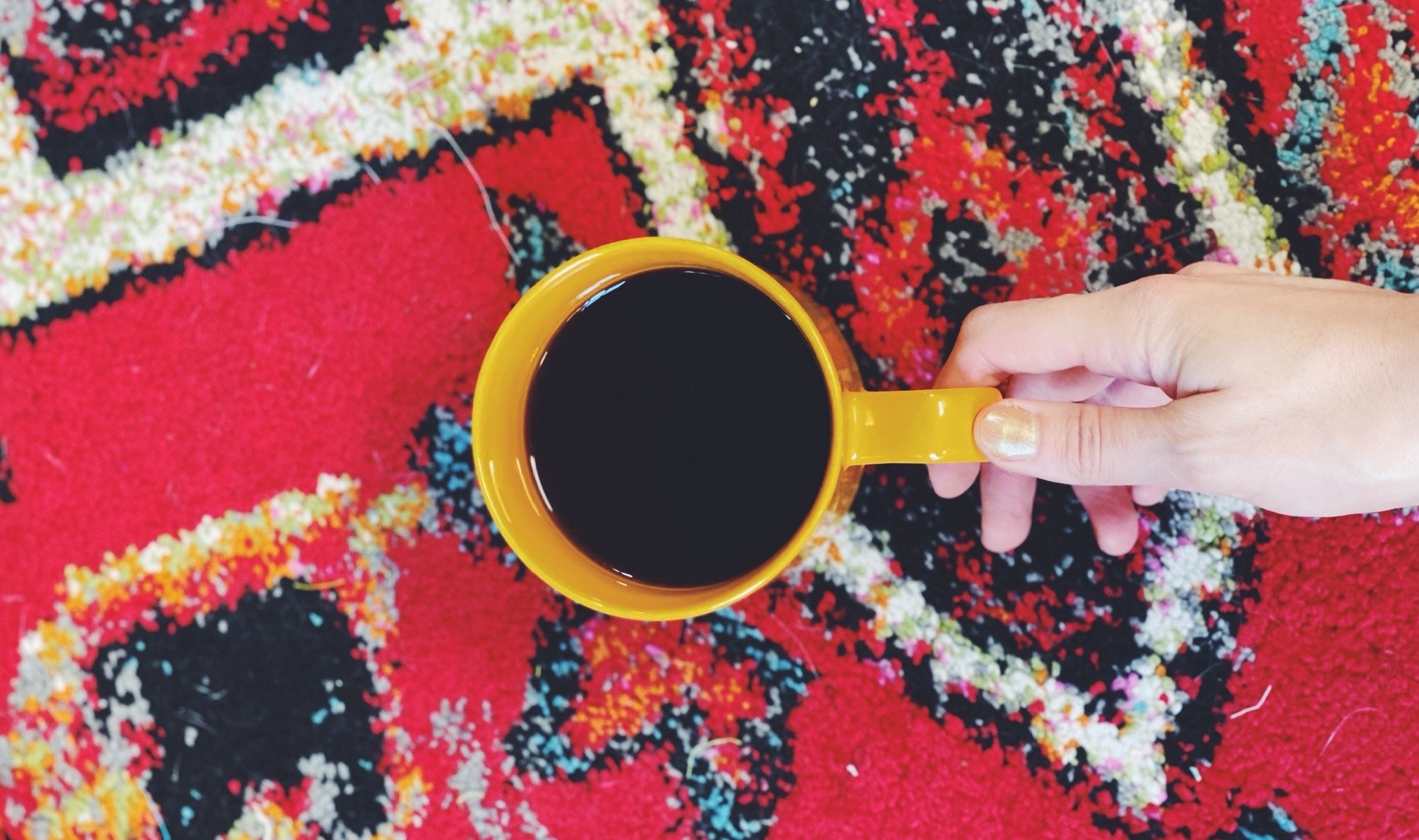
If you’re like us, there’s always a little coffee left in the brewer and a little more left in the cup. Maybe some of it is black and some has a splash of milk and a little sugar. If you typically toss it down the sink when it’s time to clean up, try saving it instead.
Why bother? Because in the future, you are going to want it, and it will be there for you. Trust us. Try a few of our favorite uses for leftover coffee—even small amounts.
Use it in your chocolate desserts
We’ve written before about how to use coffee in your cooking. If you have some coffee already in the fridge, you’ll be ready to go the next time you need it. No need to grab your cold brew or make a small amount of fresh coffee for a recipe.
Coffee enhances the flavor of chocolate, balancing the sweetness to deepen the taste and complexity. If you’ve never tried it, now’s your chance.
Things you can do with ½ cup or less of leftover coffee:
Swap ½ of water or milk in the recipe for ½ cup of black coffee.
Add a couple of tablespoons to a frosting or ganache recipe.
Make ice cubes for your drinks…or your face
Whether your leftovers are black, milky, sweet, or flavored, you can add coffee ice cubes to so many drinks for an unexpected flavor punch.
Of course, you can use it instead of regular ice cubes to flavor your cold brew so it’s never watered down. Or you can add the ice cubes to sparkling water or these cold brew and tonic mocktails.
If you’re freezing black coffee, you can even use those cubes on your face for a quick depuff. Caffeine is a known vasoconstrictor (it shrinks little veins) and so is ice! Together, they can be a nice skin pick-me-up.
Try tracing a frozen cube of coffee around your face and under (but away from) your eyes. You don’t need to use up the whole cube. Just give it a few circles around the forehead, cheeks and chin. It’s bound to feel extra good on a hot summer day.
Flavor a smoothie or oatmeal
If you enjoy a cup of coffee with a morning smoothie or bowl of oats, try a breakfast mashup by replacing some of the liquid in your smoothie or oats with an equal part of leftover coffee.
Our chocolate peanut butter smoothie makes a devine breakfast or afternoon treat.
For the oatmeal, try creating overnight oats with one part oatmilk and one part coffee. If your leftovers already have a little sugar and milk, you can probably just use the coffee alone.
How to save your leftover coffee
If you’re making ice cubes, we recommend you set aside one cube tray that you only use for freezing coffee. If you fill it before you’re ready to use it all, pop the cubes into a labeled, reusable freezer bag.
To save the leftovers for baking or smoothies, grab a mason jar and some masking tape. Label the jar “leftover coffee” and add your leftovers in the same jar each time. As long as you use the coffee consistently and wash out the jar once a month or so, you’ll always have a few tablespoons ready to go when it’s treat-making time.
The reusables we are loving now
Always looking for ways to ditch plastic? Us too! Here are three reusables we have with us this summer.

Looking for a new way to ditch plastic?
Us too. Here are our three favorites for the summer.
Do you dream of a world with less trash? Us too. In fact, it is our mission to help eliminate single-use paper coffee filters, clean up our local beaches, and minimize the trash we create as a family and a community.
We’re always looking for ways to reduce our footprint further without investing in expensive, time consuming or complicated products and strategies.
That’s why we’ve sung the praises of simple and economical things—mason jars, the French market bag, and DIYing your own veggie stock and plant-based milk. And we’ve slowly been adding to the list of favorites, tried and tested by our family and friends.
Here are three more favorite—inexpensive and simple—reusable products to help eliminate trash.
See-through, glass, reusable straws
If you need or prefer to use a straw when you drink, and if reusable is an option for you (we know it isn’t for everyone!), there are many reusable straws on the market. We’re in love with these glass straws because they solve some of the issues we’ve had with other types. The biggest one? Seeing that they are clean.
If you’ve used a metal straw for a smoothie and didn’t clean it right away, then you know the anxiety of wondering if you’ve gotten it fully cleaned out. Even with the straw brushes, you can’t always tell. These clear, glass straws mean you can see clearly.
And yes, they are sturdy—stronger and more break resistant than regular glass. The six pack comes with three straight and three curved, plus a cleaning brush.
Thrifted or sewn napkins
This may be one of the easiest, cheapest and most overlooked reusable we know. The next time you’re at a thrift store, estate sale or secondhand shop, go looking for cloth napkins. You can usually snag them cheaply and in bundles. You may find soft cotton, cute vintage or classic linen cloths in every color.
Buy more than you think you’ll need and put a few in every bag you own. You will use them.
If you’re crafty, they are super easy to sew from old sheets, shirts and other spare cloth.
Utensils from home
For ages, every single time I ordered takeout and opened a pack of plasticware, I cringed. I’ve seen several travel packs of flatware, chopsticks and other utensils, and finally bought myself one.
Then two things happened: The flatware that arrived was not as sturdy as I had hoped and a spoon broke off in a particularly cold scoop of icecream. Looking for a more sturdy replacement, a friend laughed and pulled out her own set of flatware—from home. She literally took a fork, spoon and knife from home, wrapped them in a cloth napkin, secured them with a band and placed them in her bag. She’s brilliant, and you can stop what you’re doing and put some in your bag right now.
Don’t want to grab your good stuff from home? You can buy utensils at the secondhand shop too!
Only together are we independent
Every leap you take, you take it together. To strengthen your corner of the country this Independence Day, start with your community.
Every leap you take, you take it together. To strengthen your corner of the country this Independence Day, start with your community.

In 2011, I decided to quit my job and become an independent business owner. The full-time job I held at the time no longer worked with the life I wanted to create for myself and my family. I knew I wanted more time—with my family, my friends, my community. And I knew I wanted to contribute what I could to my corner of the planet.
I had been brewing up the idea of CoffeeSock, and I was ready to make a go of it. And I haven’t looked back since. Do you know what else I haven’t done?
I haven’t been independent.
An interdependent business
My family and friends were there cheering me on, even helping to cut and sew those early socks. Then there was my Sock team, a group of amazing makers out creating their own stories when they weren’t at the factory bringing the business to life. (You can meet them, here!)
And of course there was and is the coffee community, from the shop owners and baristas who championed our product and helped make it better, to the roasters and distributors. And yes, the coffee drinkers who were thirsty for a more sustainable, simple and ritualistic way to enjoy their brew.
The truth is, no person or business is ever fully independent. No family and no community is fully independent. We rely on each other. Sometimes a little and sometimes a lot.
We are interdependent. And we celebrate that beautiful fact this July (and every month, really).
Independence requires stronger ties
What does it mean to be independent? Does it mean you do everything yourself? Does it mean you never rely on anyone else? Does it mean you have no limitations or outside controls?
I don’t think so. Not exactly. To be independent means to understand the nature of your ties and choose them for yourself. It means you choose to whom you are bound, on whom you rely, what limitations and controls you freely accept as a means to live the life you choose.
It might sound strange to say that you can be freely bound. But it’s true. As a mother and wife and daughter and sister, I choose to bind myself to my family in ways that support and nurture them and me. This may sometimes mean I take on burdens and limitations that strain me in the moment. It also means that we all can rely on each other in turn, as we need it.
It’s pretty obvious to see with children and elders. They can enjoy more freedoms and choices the more community they have to support them. Our elders can enjoy independence for longer when we support them more frequently. Our children can grow more independent when we provide the scaffolding and limits they need to succeed.
And it’s true for all of us, regardless of age and ability. We are each more free and independent because of our ties.
To strengthen your corner of the country this Independence Day, strengthen your community
These last few years, few months, few weeks—they have been EXTRA. At times, I have felt hopeless and wondered if we are irreparably broken and divided as a society. In those times, I find great solace in my chosen communities. Those whom I live with and near, and those much farther away who I connect to through my business or our shared love of beekeeping or sustainability.
I find solace in the Earth herself, my beloved Texas beaches and the forests and mountains I visit every chance I get.
These places and people make up my community, and in my moments of deepest doubt, they lift me up and make me stronger and remind me to grow myself and grow my community.
If you’re reading this, you are part of it too. Thank you for making me stronger and more independent. May you be stronger in your ties and grounded in your independence, too.
The healing power of slow coffee
In a world of fractured attention and constant movement, the practice of slow coffee offers a daily moment to refocus and reground. It’s a daily act of self care that costs little money and requires no special tools. When the world feels overwhelming, slow coffee offers 10 minutes of calm.
In a world of fractured attention and constant movement, the practice of slow coffee offers a daily moment to refocus and reground.

What if you stop reading this and notice the miracle of your senses? Yes, right now. All five of them. What do you see? Do you hear anything? Listen harder. Touch something nearby, and notice its texture. Are there smells? Tastes?
Whether you’re sitting comfortably at home or on a crowded train, to anchor in your senses brings you out of the jammed space of your head, out of the past and away from the future, and back into real life now. It’s a transformative habit, this pause. It offers clarity, calm, and healing.
There are many ways to experience this. By far one of our favorites is the ritual of slow morning coffee. It’s a daily act of self care that costs little money and requires no special tools. When the world feels overwhelming, it provides 10 daily minutes of calm.
Slow coffee as pause
To pause requires patience in a world accustomed to convenience and distraction. Deliberate slowness is an act of resistance. I find this especially true at breakfast, a time when the pleasures of crispy toast and strong coffee are easily turned into mechanized experiences meant only to fuel some future productivity.
Slow coffee is a daily rebellion. A moment to give your brain a chance to reset—a reprieve from yesterday’s messes and today’s to-dos.
Here’s how to slow down and take back your morning coffee.
Go analog. Silence your notifications. Leave your phone in a different room. Try to give yourself these minutes distraction free, if possible.
Savor the smell. You may grind your own or buy it pre-ground. Either way, coffee smells amazing. Notice it. Give yourself at least five full seconds to soak it in.
Look and Listen. Watch the water pour from the pitcher or the tap. Listen as it fills the kettle or the brewer. Don’t look away. Water is one of nature’s most powerful forces. Appreciate the heck out of the fact that you have it right here in front of you.
Feel all the textures. The ground coffee, the water, the kettle or brewer, your favorite mug—they all have a different texture. They are all made up of elements, just like you. Notice the differences. Notice the sameness.
Wait. Now for the hardest part. You wait. The brewing or boiling of water takes its own time. Resist the urge to check your phone. Don’t prep your to-do list or get a head start on absolutely anything. Your only activities are for the present moment. Do some gentle stretching. Sit and watch the kettle slowly warm. Count your breaths. Notice the sights, sounds, and smells of the brewer.
Pour and watch. If you use the pour over method, there’s still the whole process of slowly swirling the water from the kettle over the grounds and watching it drip through and turn into liquid magic. So satisfying!
Savor. This may be the best moment of all—time to pour the brewed coffee into your favorite mug and enjoy the rising steam. In another act of patience, you must wait a minute or two before drinking so you don’t burn your tongue. Savor the smell, the heat, the dancing steam.
Express gratitude. When it’s time for the first sip, really notice the flavors and the chain of efforts that brought this moment to you. Consider saying “thank you” out loud. Because it’s all a modern miracle when you really think about it.
When life interrupts your slow coffee
It’s inevitable. Unless you live deep in the woods away from all distraction, life will insert itself into your slow coffee. The dog will bark, a child will wander into the kitchen demanding cereal. Your partner will need to find a missing paper. Someone will knock on the door.
All is not lost. Pet the dog. Hug the toddler. Kiss the partner. Answer the door if you must.
This is your chosen life. Your one and only. Give it the attention it deserves. Then soak right back into your moment. Because now is always here for you. Right up until the day that it isn’t.
3 tricks for the best poolside or beachside coffee
A cold coffee after a swim? You’ll thank us for these tips to make it happen. Hint: It involves coffee-flavored ice cubes, pre-mixed flavorings, and our forever favorite—the mason jar pour spout.
Hint: It involves coffee-flavored ice cubes, pre-mixed flavorings, and our forever favorite—the mason jar pour spout.

As May turns to June and the northern hemisphere warms to summer, many of us will head to the closest body of water to relax and keep cool. And while water is the beverage of choice to stay hydrated, a cold, lightly sweet coffee drink makes an exceptional afternoon and after swim treat.
We’ve compiled our three favorite tricks to keep your cold brew actually cold, not watered down, nice and sweet, and ready to pour.
Make coffee ice cubes
Depending on how much you want to bring, the cold brew container can take up valuable cooler real estate. Use the cold brew to make ice cubes and problem solved.
You can go about this a few ways. If you make the cubes with sweetener, then you can skip the sweetener on the side. If you pack your jar with mostly ice cubes, then you don’t need to put the cold brew in the cooler at all—at least not at first. Just pack a large mason jar full of the ice cubes and let it slowly melt to cold, slushy coffee.
How to make coffee ice cubes
Make your cold brewed coffee (see our basic instructions or check out our many recipes.)
Add simple syrup to taste, flavored or plain, if you want the melty cubes to sweeten your drink
Pour into an Ince cube tray and freeze
Add your coffee ice cubes to your mason jar, fill with cold brew, and add to the cooler. With the ice cubes inside the coffee container, it will help keep everything else cool too! Or, like we said, just make ice cubes out of the whole batch.
Premix your favorite flavors
If you like your cold brew straight, then you can skip this part. If you want the whole batch milky and sweet, then mix it right into the container. If your group is like ours, then everybody wants their coffee custom made.
Fair enough. You can premix a couple of options and have them at the ready. Here are our favorite post-swim coffee mix ins:
Simple syrup is always a favorite. You can flavor it with just about any flavoring and it does not need to be kept cold. Simply mix 1 part sugar and 1 part water and heat together on the stove until the sugar is dissolved. Mix in vanilla, cinnamon, chocolate, orange, mint, more coffee… the choices are endless. Let the mixture cool and pop it into a container with a tiny spout—like the kind you use to dispense mustard.
Presweetened milk does require cooler space…but it’s worth it if vanilla coconut milk cold brew or maple spiced cold brew make you smile. Again, make the flavored milk at home, add it to a pourable container, and stash it at the ready.
Bring a pour spout for your mason jar
Mason jars do absolutely everything. They are sturdy, inexpensive, high quality, and nice looking. Yes, they are glass, which you might not want to bring to the pool. If that’s the case, consider shopping for a quality plastic version. The size it perfect and you can mix and match the lids with standard mason jar lids.
And the best part is this: You can add a pour spout to the jar.
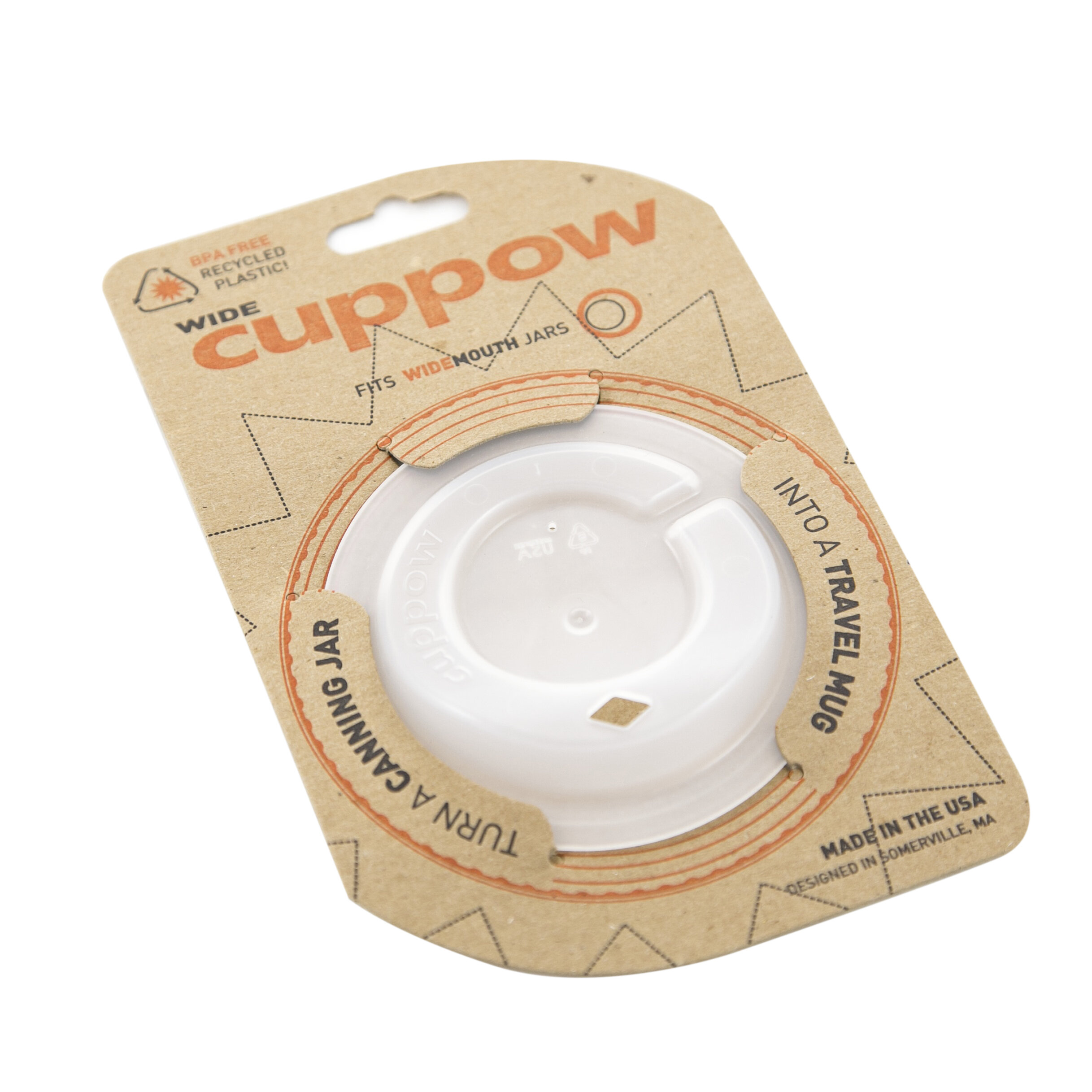
We’ve been using our Cuppow mason jar pour spout for years. You just remove the inner circle from the lid and replace it with the Cuppow spout. It’s genius and we wish we would have thought of it.
Enjoy your poolside or beachside coffee!
Pre-swim, post-swim…during swim? Either way, we hope this inspires you to try cold brew at your next outing. Don’t forget the plastic tumblers to drink out of and sure, little umbrellas if that’s your thing.
Enjoy!
Why we love the classic French market bag
They’re easy to store, have a million uses, and expand to hold all the produce you want to buy. That’s why we love French market bags—they’re an earth-friendly forever classic.
They’re easy to store, have a million uses, and expand to hold all the produce you want to buy. That’s why we love French market bags—they’re an earth-friendly forever classic.

You probably have a lot of reusable bags. There’s the bags by the front door, the ones in your pantry or under your sink, the ones you have handy for your plane, train, or automobile commute, and the ones you have stashed inside of other bags!
And if some of those bags are the retro French market variety, then you already know what we’re about to say. These bags are some of our favorites.
Why? Because they’re inexpensive, super easy to stash anywhere, expand to hold a lot, and they double as air driers.
Need to be convinced? This is our ode to the French market bag.
Small but mighty
These string bags have been around for more than a century—for good reason. Fishermen have known for ages that the woven string structure can support a lot of weight as they haul up literal tons of wet fish each day.
The story goes that in the 1800s in Normandy, France, some genius started using the same material to make bags for carrying goods back and forth to market. And these iconic bags are still made in France, though we’ve caught on here in the states too.
Unfilled, the bags are small and can fit just about anywhere. When you’re ready to shop, you can load a high-quality market bag with 30+ pounds of goods. (Although we wouldn’t want to carry a bag that heavy home from market.) This flexibility is key for shopping, as anyone knows who has tried to arrange items from the store into less flexible bags.
They double produce storers
Once you’ve got those onions and potatoes home from the market, the best storage method may be the same one you used to bag them up. Lots of veggies prefer to be stored in a cool, dark and ventilated space. If you can hang a mesh bag of onions in a cool place away from direct sunlight (think a pantry, cabinet, or shadowy kitchen nook) the air flow will help them last longer.
They triple as air driers
When I was a kid in Girl Scouts, we brought our own reusable dishes and eating utensils in mesh bags. After we used our personal set, we washed them, put them in the mesh sack and strung them up to dry. No dish rack needed and definitely on paper plates or plasticware.
Same thing for our wet swim suits and other washable cloth. Just toss them in the bag and hang on a tree branch and they’ll be dry and ready wear by morning. (But do check the forecast for rain.)
Bonus: They’re affordable, cute, and will last a long time
Of all the products you can buy with the “eco-friendly” label, not many will cost you less than $10 and last you for years. But our favorite French market bag costs $7.
Interested? You can pick one up right here at CoffeeSock.

3 reasons to choose shade-grown coffee
Coffee grown in the sun produces more coffee faster, but it’s not great for the life and livelihoods of those who grow coffee, for the environment as a whole, or even for the flavor of the brew. Here’s why to seek out shade-grown coffees.
Coffee grown in the sun produces more coffee faster, but it’s not great for the life and livelihoods of those who grow coffee, for the environment as a whole, or even for the flavor of the brew.

If you love coffee, you already know that quality beans matter. But did you know that the way the beans are grown matters too?
The coffee plant first grew in forested, shady areas. As farmers began to cultivate and grow coffee to sell, the demands of the market led to more and more sun-grown varieties. Why? Because sun-tolerant plants grow faster, leading to more crop yields. And if you can clear away trees for more land, then you can grow more coffee too. In other words, the sun-grown variety brings short-term profits.
Sun-grown coffee varieties can have their place in a sustainable coffee farming ecosystem, but on their own, they can deplete the land, ruin local ecosystems, and impoverish the farmers that grow them.
Here’s three reasons to choose shade-grown coffee.
Shade-grown coffee preserves local ecosystems
In forested areas, shade-grown coffee means that farms do not need to clear out trees. Instead, the forest canopy that shades the coffee plants, provides habitats for local birds and other wildlife. This is why the Smithsonian’s Migratory Bird Center developed the “Bird Friendly certification” for coffee and cocoa.
According to the organization, “When you purchase Bird Friendly® certified coffee or cocoa, you preserve critical habitat for birds and wildlife, fight climate change, protect biodiversity, and support farmers committed to conserving bird and wildlife habitat by farming sustainably.”
And what is good for the wildlife is good for the local and global environment, maintaining the rainforests, reducing carbon emissions, and preserving the soil.
Tree-filled farms offer additional food and income for farming families
According to Food4Farmers, “Coffee is not enough.” When farms produce only coffee, then they lose income when prices drop and can be devastated by crop failures and diseases. And even those farms that produce certified fair-trade coffee rarely bring in enough income through coffee alone. As a result, coffee farming families can go hungry even as the world demands more coffee.
The trees in and around farms that grow shade-grown coffee provide a wealth of food and income opportunities. With support from organizations such as Food4Farmers, these farms can develop practices such as agroforestry and beekeeping.
Through agroforestry, local communities select and cultivate trees that bring specific benefit to that community, such as fruit trees for more food options, shade trees for the coffee plants, and even trees that can eventually be used for lumber.
As for beekeeping, the practice provides additional food and additional income. And the trees that shade and surround the coffee farm provide an ideal environment.
While coffee itself provides few nesting sites and food for bees, bee diversity and abundance depend on the presence of trees inside or around the coffee farm — demonstrating an additional benefit of shade-grown coffee.
In short, the trees in and around shade-grown coffee farms help ensure the farmers have livelihoods that don’t depend entirely on the coffee market.
Bonus: Shade-grown coffee tastes great
For the environment and the livelihoods of farming families, we’re sold on shade-grown coffee. So, it’s a real bonus that it tastes great too.
Of course, many factors determine the taste of the coffee in your cup, from the roast of the beans to the tools you use to brew. But it all starts with the bean.
Consider these factors of shade-grown coffee:
The coffee is grown in an environment that resembles its natural environment, producing high quality beans.
The soil on a shade-grown farm is likely healthier soil in a more biodiverse environment.
The plants grow slower, producing a fully mature bean.
While there’s no scientific proof that it tastes better in the cup, there’s plenty of proof that shade-grown plants are grown in biodiverse farms using more sustainable practices to produce a high-quality bean.
CoffeeSock supports Food4Farmers through 1% for the planet
Did you know? CoffeeSock is a member of 1% for the Planet. That means that 1% of our sales—and more during certain times of the year—goes to support Food4Farmers and their work at Maya Ixil coffee cooperative, a group of 205 coffee farmers in the northwestern highlands of Guatemala.
Read all about it. We thrive when farmers thrive: Our commitment to the Maya Ixil coffee cooperative.
How small, women-owned businesses lift all women
When we support small, femme-owned businesses, we support issues that affect everyone—pay equity, child care, equal opportunity, and civil rights for all. Here’s 7 reasons why.
When we support small, femme-owned businesses, we support issues that affect everyone—pay equity, child care, equal opportunity, and civil rights for all. Here’s how.

Corina Guillory, founder and owner of CoffeeSock
In 2011, Corina Guillory started sewing and selling CoffeeSocks from her house. It was both a finish line and a beginning. As a young mother and wife with a big dream, she knew there was a more sustainable way to have her dream career while also being present for her beloved family. So she quit her full-time job and invested fully in this new venture.
Her dream? A sustainable world for herself, her family, her community and the world. She believed then and now that big, global changes radiate out from communities of individuals. It’s how we heal people and the earth.
When we support small businesses owned by women, like CoffeeSock, we invest in the means for women’s autonomy. It’s pretty simple—women will hire other women. They will pay women equally to men. They are more likely to support family-friendly work environments. And they are more likely to invest in the surrounding community and promote equal opportunity across all intersecting racial, cultural, and sexual identities.
Don’t take our word for it. Consider these facts:
According to a 2013 U.S. Trust Insights on Wealth and Worth report, “successful women are more likely than successful men to own a business so they can pursue a personal passion and to make a positive impact on the world.”
Global Women’s Entrepreneurship Research reports that women are 1.23 times more likely than men to start businesses based on environmental principles rather than economic ones.
According to MetLife’s Employee Benefit Trends Study, “female small business owners are more likely to recognize when employees are stressed, tired, or burned out.”
That same study shows that female small business owners are more likely to recognize the importance of employee benefits that meet the needs of diverse employees and employees in different life stages, including those who are parenting, sick, or caring for aging parents.
Research on startups shows that “a company with a female founder and a female executive will hire 6x more women.”
“Studies show women reinvest up to 90 percent of their income in their families and communities, compared to 40 percent for men,” according to Women Owned.
Nerdwallet reports that in 2020, “40% of US businesses are women-owned” and in 2019, “64% of new women-owned businesses were started by women of color.”
To own a business can be liberating. It can also be an economic necessity. The pandemic pushed far more women than men out of the workplace, and ongoing discriminatory policies and corproate environments lock still other women out, especially women of color, trans women, and women with disabilities. When women own their businesses, they have the means to own their lives.
As Women’s History Month 2022 comes to a close, you can invest continually in femme futures by shopping from femme-owned small businesses.
We’re so glad you’re part of the CoffeeSock community. We are proud to offer simple, sustainable, and economical products across the globe. We employ a rad group of women artists and leaders to produce products that add value to our community far and wide. And we’re proud to support the Austin, Texas economy and contribute to the city’s civic life. That’s what small, femme-owned businesses do all over the globe.
Sources
Why we use a Chemex for brewing coffee at home
If you’re looking for a coffeemaker that’s simple, beautiful, and makes a whole pot of coffee, the Chemex fits the bill. It’s the brew method we use most often at home. Add a CoffeeSock organic cotton filter, and the Chemex meets our coffee needs and matches our values—simple, economical, and ecological.
If you’re looking for a coffeemaker that’s simple, beautiful, and makes a whole pot of coffee, meet the Chemex.
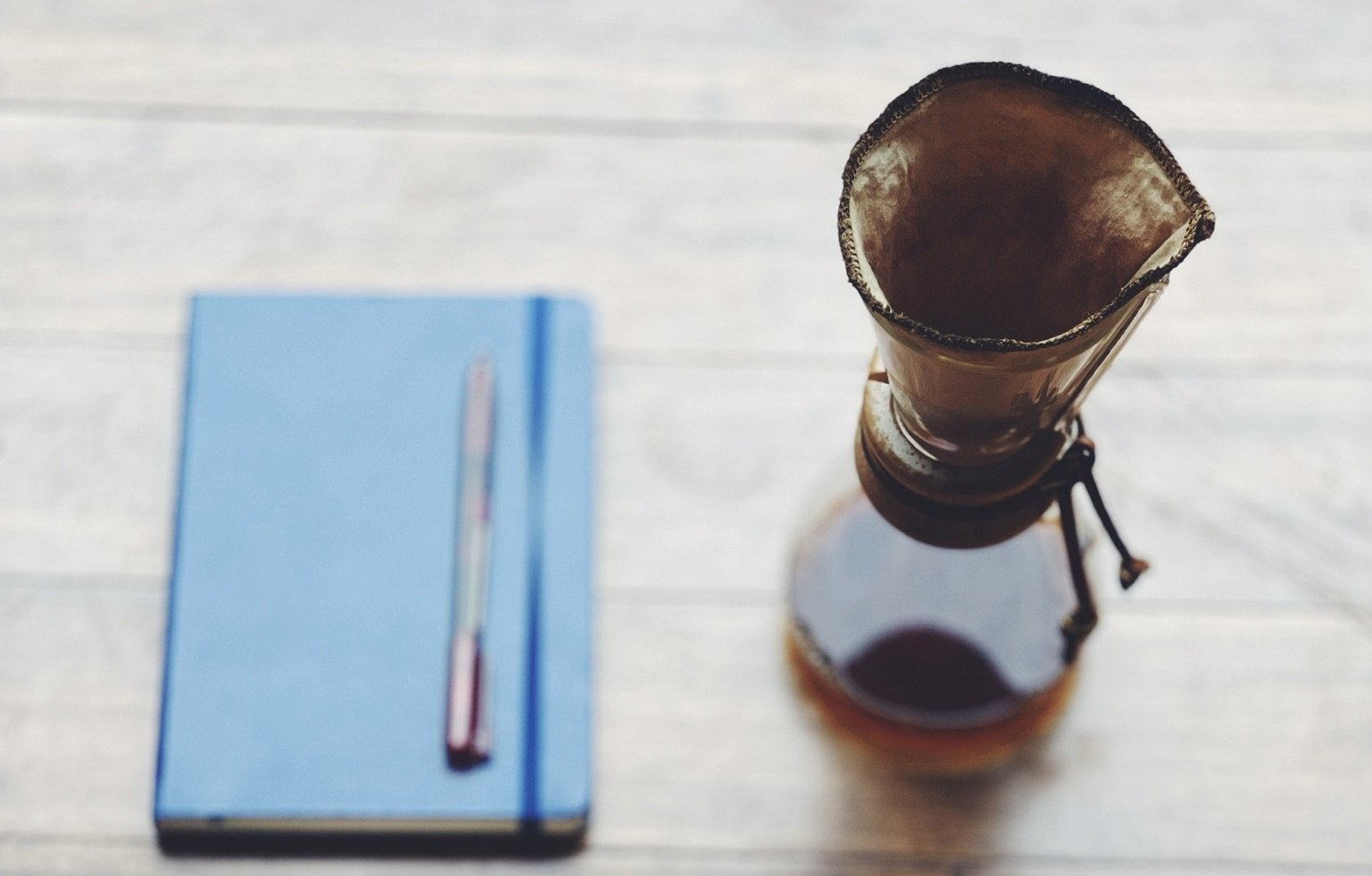
Let’s just get right to the heart of the matter—the Chemex brewer is simple, beautiful and makes a great cup of coffee—or eight. For these reasons, the brewer has a large and dedicated fan base. And it’s why the Chemex is the brew method we use at home.
That’s the short version of the story. The longer version is about your own needs and values when it comes to coffee. For us, we drink multiple cups of coffee daily, so we need a brewer that produces several cups at a time with a consistently great flavor. And we value simple, economical and ecological things, with huge bonus points for being beautiful.
What are your coffee making needs and values? This explainer can help you figure out if Chemex is the brew method for you.
(We’ve also written about the Hario V60, the Aeropress, the automatic coffeemaker, and cold brewing. Check those out too!)
Your needs and values = your best brew method
For most of human coffee-drinking history, we used simple brewing methods that involved boiling water, mixing it with ground up beans, and putting the results through some kind of sieve. There were not a ton of options.
It was hundreds of years later—the early 1900s—when Melitta Bentz invented the first paper filter in an attempt to remove some of the bitterness of the brew, though her filters were not widely used until a few decades after that. From there, the world’s coffee making options multiplied, with methods that used some combination of pressure, steam, electricity, filters, plungers, and gravity.
In short, nothing about your preferred brew method is a given. Instead, you can choose the brew method that best meets your needs and matches your values.
Do you need multiple cups on a daily basis? Is speed important? Precision? The ability to use a kitchen scale to get the water-to-grounds ratio just right? How much storage space do you have? How important is simplicity? Do you have a kettle?
You get the idea!
What is a Chemex and why would you want one?
According to the Chemex company’s website, the Chemex was invented in 1941 by chemist Dr. Peter Schlumbohm. He wanted a brew method that combined simplicity, excellent coffee, and art.
“Schlumbohm desired to not only make brewing the perfect cup simple, but also to have the vessel be a thing of beauty. Being a chemist, he studied and understood clearly the chemistry behind the extraction of flavor and caffeine from coffee beans.”
It’s hourglass shape is designed with coffee science in mind to brew a great cup. And it’s probably the only coffee maker regularly featured and sold in art museums.
Here are the advantages of the Chemex:
It’s simple. Add a filter, ground beans and hot water. That’s it.
It’s beautiful. You can leave it sitting on the counter and it looks great.
It’s economical. It will last for decades and costs less than $60 for an 8 or 10-cup classic brewer. Even if you decide to be fancy and buy the $150 13-cup handblown version, it’s a steal considering its durability and beauty.
It’s a pourover option for multiple cups. Whether you have multiple coffee drinkers in the family or guests visiting, you can easily make 6, 8 or 10 equally delicious cups.
What about the special Chemex filter?

If you’re familiar with Chemex brewers, you’ll know that Chemex makes their own special paper filter. According to the company, they use “bonded filter paper to remove bad fats, bitterness, acidity and sediments that all other types of filters leave behind.”
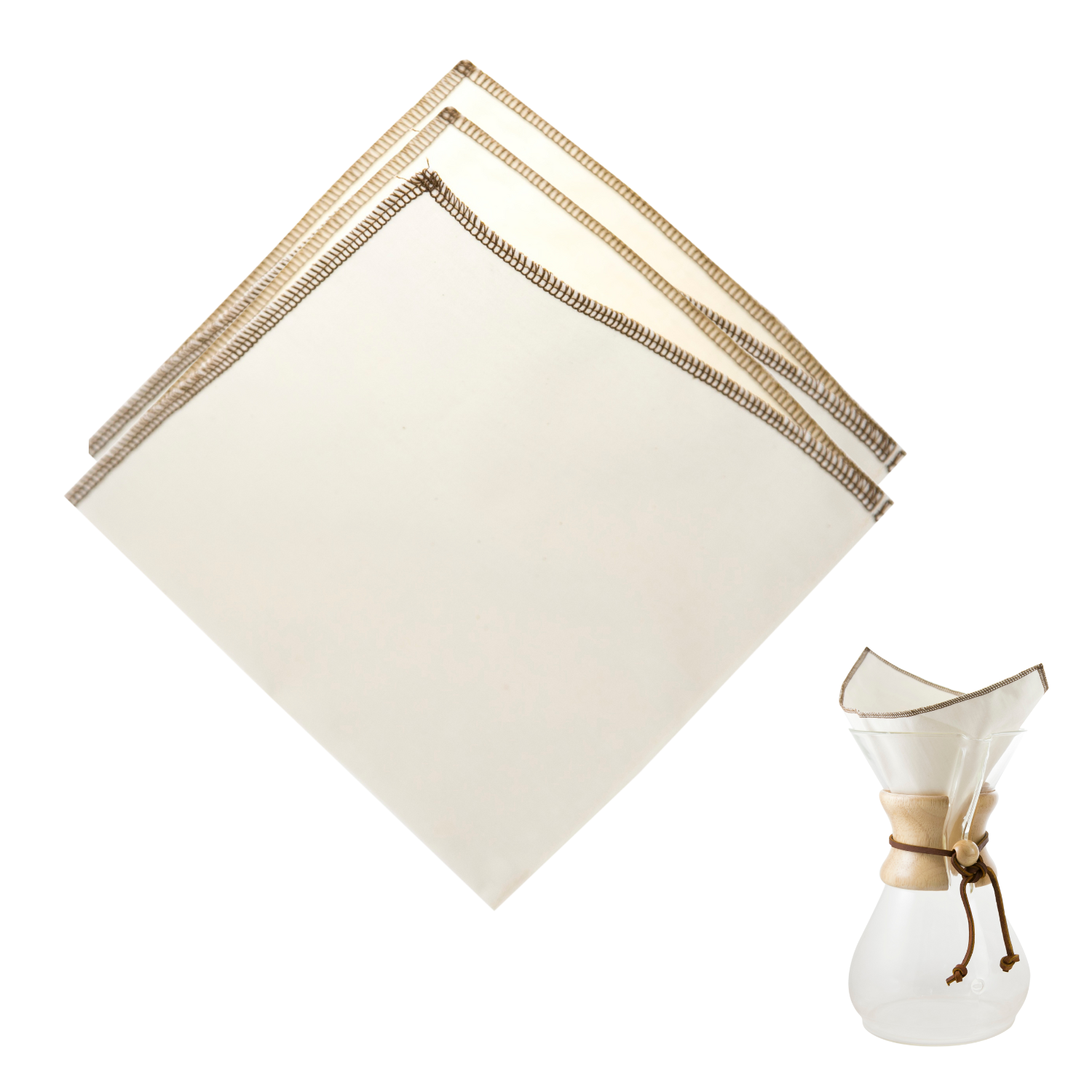
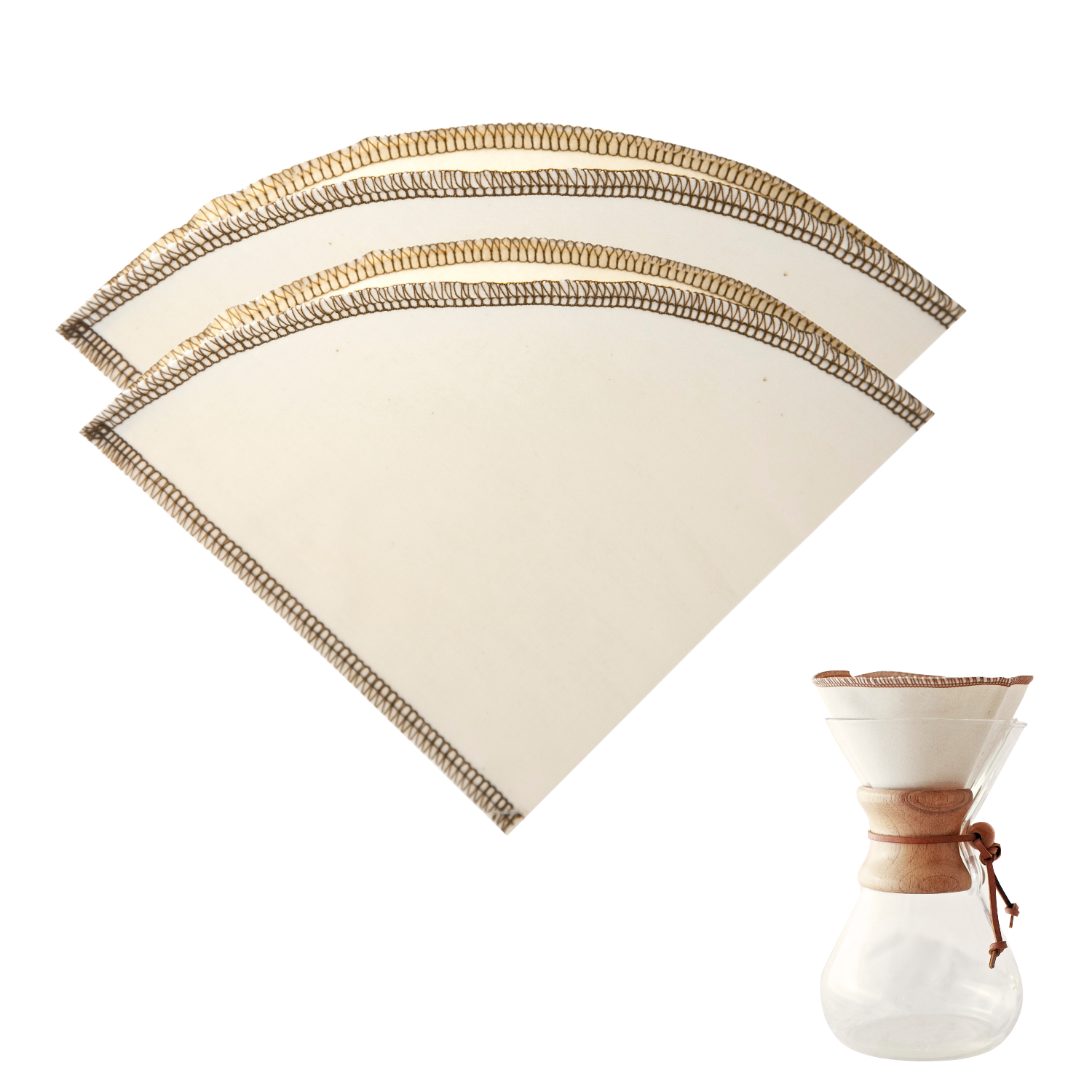
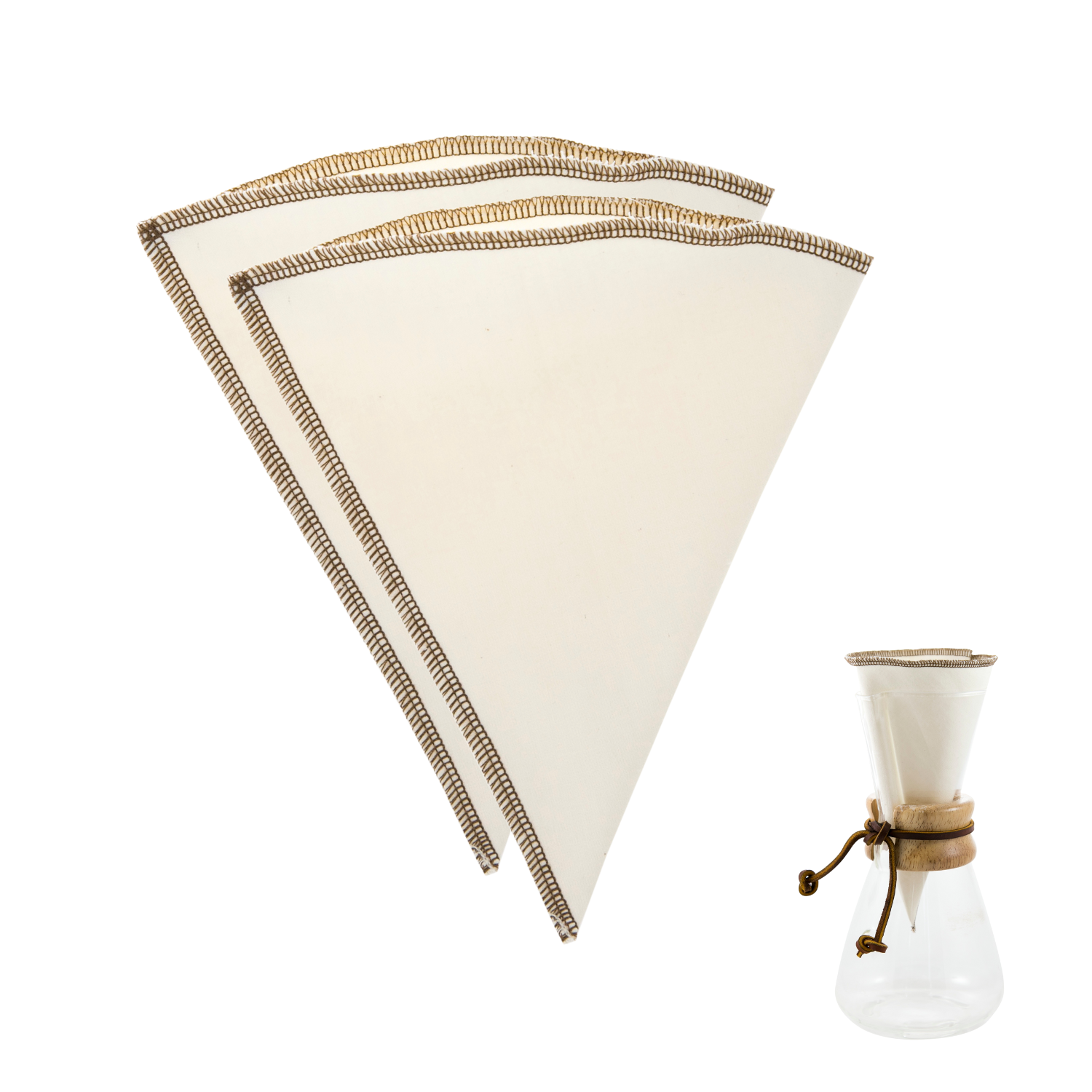
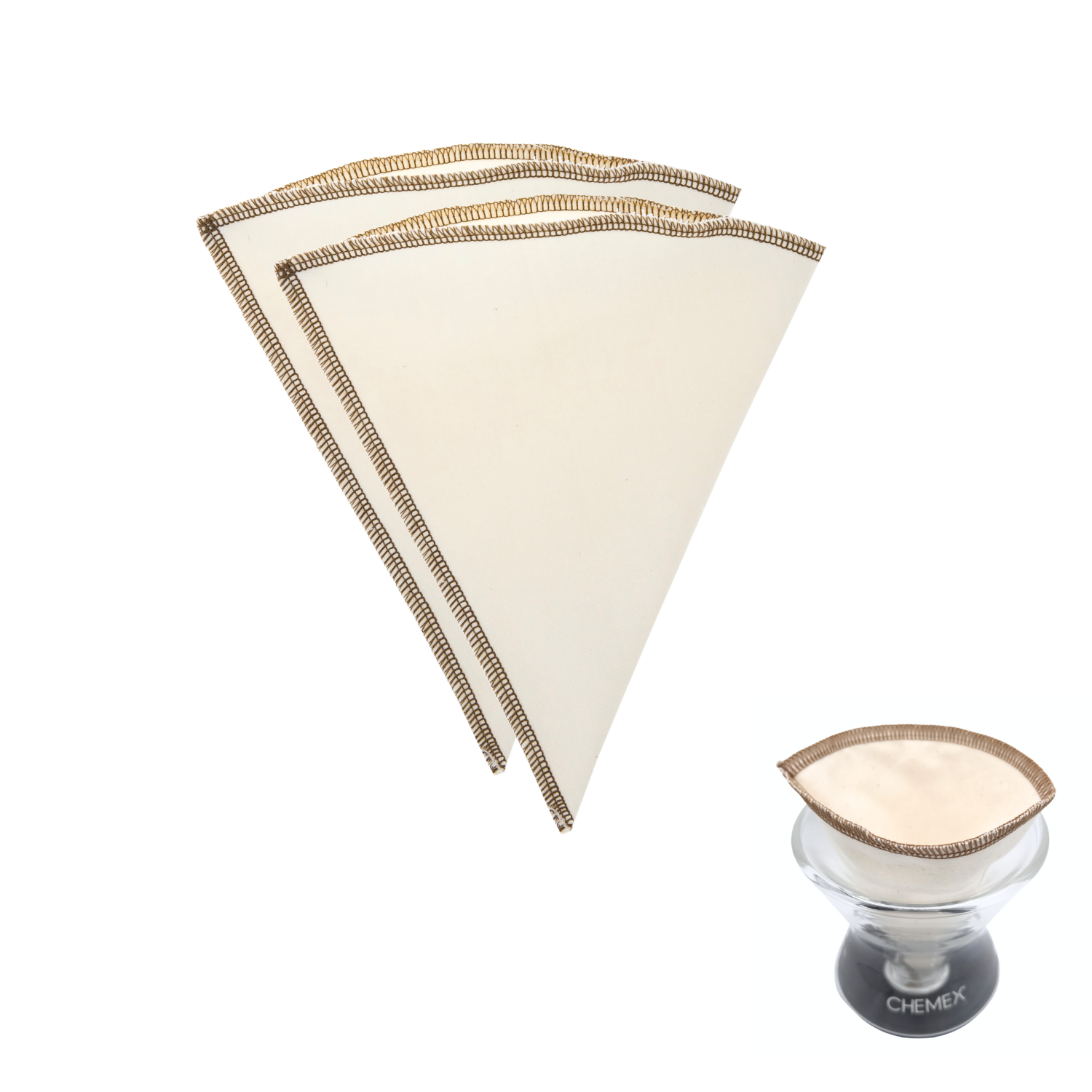
Because CoffeeSock values simple, reusable, and ecological materials, we designed our organic cotton Chemex filters to work just as well as the lab-grade Chemex paper filters, but without the paper waste. In fact, organic cotton produces a brighter brew with a more balanced acidity level than paper.
Each organic cotton filter lasts from six months to one year, depending on how often you use it. And a three pack costs only $14. You can even buy a 3-cup or 8-cup Chemex brewer with filters directly from CoffeeSock!
How to brew coffee with your Chemex
With Chemex, you’ll start with a medium ground coffee, on the coarser side if you’re using their paper filters.
For four cups of coffee, use around 50 grams of ground coffee and 750 grams of water.
From there:
Boil your water in a gooseneck kettle.
Dampen your cloth or paper filter with warm water and discard the water.
Line your Chemex with a filter and place on a kitchen scale. Zero the scale.
Add 50 grams of ground coffee to the filter.
Using a wide circular motion, pour about 100 grams of the boiled water onto the grounds and let stand for 45 seconds to one minute. This is the “bloom” when the coffee de-gases.
Pour the remaining water using the same large, slow circles, pausing occasionally to let the coffee drip through a bit before continuing.
After pouring all of the water (measuring by weight) allow the coffee to fully brew and drip through.
Toss the grounds in the compost. If using cloth, rinse the coffee filter and hang to dry for next time.
You can keep your coffee warm by placing it on a glass stove top or gas flame on low. (Don’t put it on an electric coil stove! Use this wire grid if you have a coil stove.
How to clean the Chemex
Most Chemex brewers go right into the dishwasher. Or you can hand wash with a gentle dish soap. Be sure to read the instructions that come with the brewer you select. Treat your Chemex brewer well and you’ll have it for a lifetime.
Let’s bring back the Coffee Klatch
Kaffeeklatsch comes from the German words for coffee and gossip, and “gossip” really just means talk about things important to women and domestic life. Which is truly everything. These days, we might be missing out on the best parts of those informal gatherings. It’s time to bring back the coffee klatch.
Kaffeeklatsch comes from the German words for coffee and gossip, and was long thought of as a women’s group that partook of both. “Gossip” in these groups was really just talk of domestic importance, which was talk of just about everything—from the mundane to the deeply political. These days, we might be missing out on the best parts of those informal gatherings. It’s time to bring back the coffee klatch.

If you were a man in the late 1600s, living in Paris or London or Hamburg, you may have been among the first to drink coffee at a European coffeehouse. You may have enjoyed a cup while discussing mathematics with Sir Isaac Newton or poetry with Jonathan Swift. You may have helped found the London Stock Exchange.
If you were a woman in the late 1600s, living in Paris or London or Hamburg, maybe you too found yourself at a coffeehouse, though probably not, unless you were engaged in some kind of work. For all but the most wealthy of women, you more likely witnessed the coffee revolution from your home.
As the centuries rolled on, coffeehouses and at-home coffee gatherings continued. In both cases, the location itself set parameters on the conversation. Where you drank dictated, to a degree, what you discussed.
While coffeehouses specialized around topics such as science or business or literature, at-home gatherings, especially those hosted by women and for women, focused on domestic life. And here’s the thing about domestic life that still holds true today—our day-to-day life is as affected by the politics of the day as it is by childcare and our favorite recipe for roast chicken. And so women then as now discussed it all.
Can we rebrand happy hour?
It’s true that happy hour may be the modern stand-in for the coffee klatch. At happy hour, we gather to discuss the news of the day, our work, our home lives, our plans. It’s a time carved out to be in community, something we desperately crave and need. It’s also a time we often associate with a focus on “happiness” and drinking culture that doesn't always gel with our current realities.
Happy hour can be, by design, a time to sever ourselves from the stresses of work life and domestic life. We are told we should enjoy a glass of wine or a stiff cocktail and relax.
The concept of many happy hours hinges on the separate spheres of work, home, and play. If these spheres were ever truly separate, those days are long gone.
It’s time to bring back happy hours, but with a bit of a rebrand. We need community now more than ever.
Let’s bring back the klatsch
The coffee klatch doesn’t ask you to put aside life, and you don’t even need to be happy. In fact, you can hold a coffee klatch on a Monday morning before your first Zoom meeting.
The purpose is community and the topic is that which is on the community mind, from navigating school closings (again!) to strategizing a career switch, swapping plant-based dinner recipes, or attending the City Council hearings about the budget. (Really only one of you needs to go for all of you to be informed.)
Happy hour can still hold court for those times when wine and celebration fill the need of the day. Let’s bring back the coffee klatsch for its own sake and in its own place. To fortify our communities, strengthen bonds, swap ideas, inspire and encourage each other, and then get it all done.
Maybe you’ll be talking to the next Marie Curie or Toni Morrison at your next klatsch. Maybe you’ll help found the Austin Sock Exchange.
(Oh, and you can also make coffee mocktails if you want to do a happy hour/coffee klatch mashup.)
Get to know the Hario V60 dripper
The Japanese brand Hario makes a popular line of beautifully designed pour over drippers. The V60’s shape allows you to dial in your perfect cup of coffee. Swap out the paper filters for cotton and get an even better brew.
The Japanese brand Hario makes a popular line of beautifully designed pour over drippers. The V60’s shape allows you to dial in your perfect cup of coffee. Swap out the paper filters for cotton and get an even better brew.
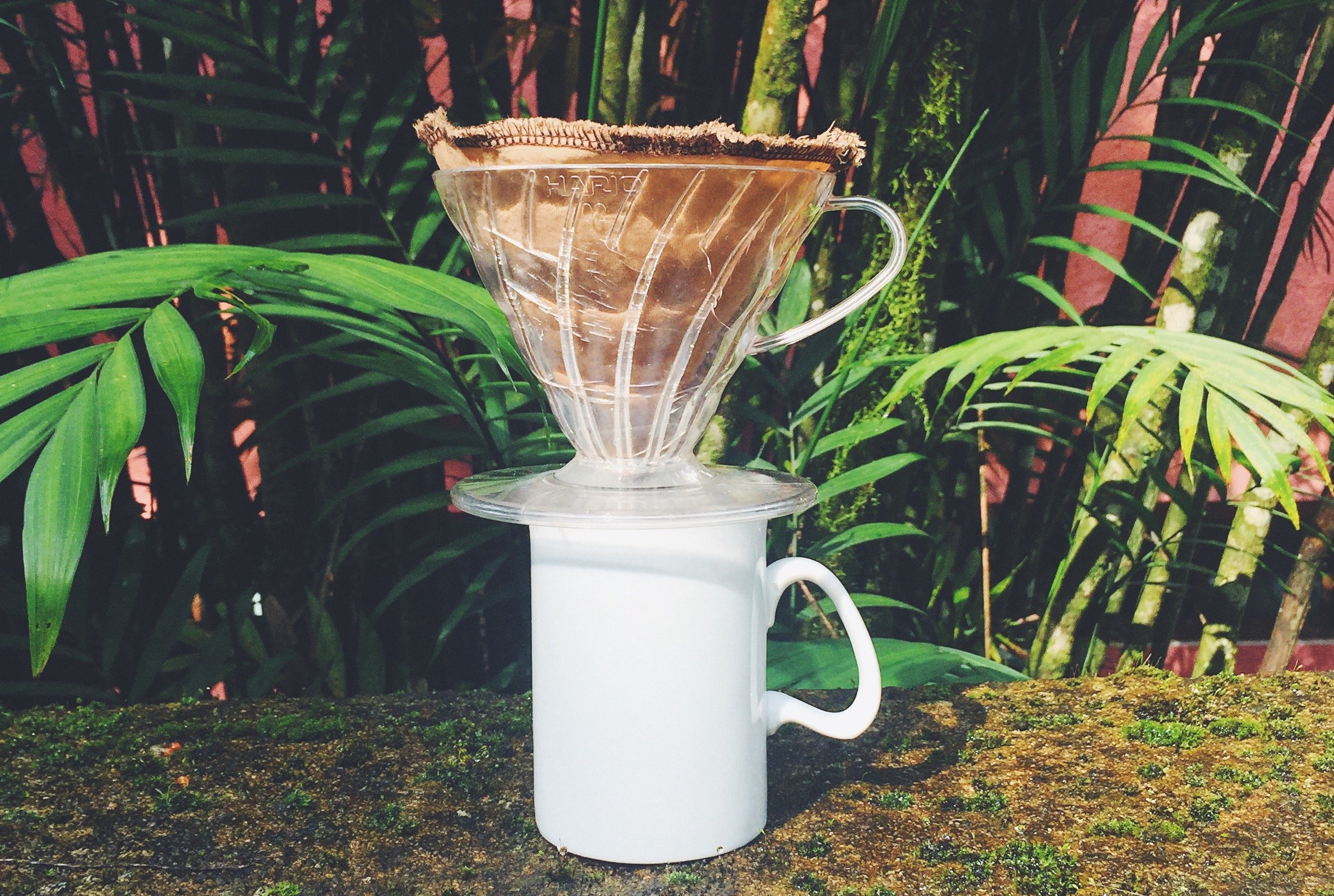
If you’re a fan of the Hario brand or just Hario-curious, you’ve probably seen their popular line of V60 pour over drippers and gooseneck kettles (perfect for pour over coffee). The V60 is popular for good reason—it’s beautifully designed, long-lasting, and comes in multiple sizes, materials, and colors.
We keep a sturdy plastic model in our camp kit for an excellent brew in the woods. And the design of the ceramic and glass models look gorgeous on a countertop and make great gifts.
But the Hario shape is about more than beauty. It gives you control over the coffee grind size, flavor, and strength of your brew. To make it even smoother and avoid any papery taste, swap out the paper filter for a reusable cotton filter specially designed for your Hario V60.
About the Hario company
The Hario company was founded in Tokyo in 1921 to make and sell glass instruments for laboratories. By the 40s, the company had researched and perfected their heat proof glass and expanded into making coffee carafes and other glasswares.
While the company has since expanded all over the world, they continue to make glass products in Tokyo.
In short, the Hario company has been researching and manufacturing high quality products for more than 100 years. And their V60 drippers and other coffee-making supplies benefit from their early research in lab instruments with an intentionally designed shape and look.
What is Hario V60?
The Hario V60 is a V-shaped coffee dripper that sits right on top of a coffee cup or serving vessel. You add a filter and coffee grounds, and pour hot water through to brew the coffee. But that’s a super basic way to describe how you make pour over coffee.
Check out our guide to pour over coffee for great detail.
If you’ve seen multiple pour over drippers, you’ll notice that the Hario V60 has a more conical shape than some and features wavy ridges down the side on the inside of the dripper. According to Hario, that’s more than a fashion choice.
According to the company’s website, “The V60's conical shape allows for deeper layering of coffee grounds, and its spiral ridges and lack of flow restriction allow the user to pour the water quickly for a delicate body or slowly for a heavier flavor.”
In other words, with slight changes to the way you pour or the size of your coffee grind, you can change the flavor of your cup to suit your liking.
How to use the V60
To make a single cup of coffee with your Hario dripper, start with about 15 grams of medium to medium-fine ground coffee and about 17 times that much water, around 250ml. For two cups, double the amounts.
Boil your water. Your water will be around 100 degrees when you pour it, give or take a few degrees.
Wet the filter. We recommend you use a cotton filter (we explain below), but whether you’re using cotton or paper, pour your hot water over the filter and into the cup or pitcher. This primes the filter, removes the paper flavor if you’re using paper, and warms the container below. Be sure to pour out the water after a few seconds.
Add your coffee to the filter and bloom. Add ground coffee to the damp filter and even it out. Some people put a small “dent” in the center with a spoon to encourage the water to flow inward through the coffee instead of outward towards the filter. Using a gooseneck kettle for maximum control, slowly pour about 50ml of hot water over the grounds in a large circle starting on the outside and moving towards the center until grounds are evenly wet. Let it sit for 30 seconds to “bloom” and de-gas.
Finish pouring the water. Pour the rest of the water in slow circles, avoiding the outside edge or the very middle. It should take about 90 seconds to finish pouring the water. You can stop every few seconds if it seems like the filter is getting too full of water.
Allow the coffee to drain through, and give the grounds a stir. Allow the water to completely drain through the grounds, giving a light stir of the coffee grounds after a few seconds to encourage the process.
Experiment with slight variations on the grind size and your pour speed to get the coffee flavor just the way you like it. If you notice the water draining too fast, use a finer grind size. Too slow? Make it a bit coarser next time.
Which V60 should I use?
The Hario V60 comes in three sizes.
The 01 is your best bet for a single serving.
Choose the 02 if you consistently want more than one cup or if you’re making coffee for up to four people.
Choose the 03 if you’re making coffee for up to six people—or two people who each want multiple cups.
Can I make one cup in an 02 or 03?
Yes, but…. If you’re trying to be efficient and choose an 03 because you sometimes serve five people but usually only want one or two cups, be aware that the grooves and opening on the 03 will alter the way a smaller amount of coffee tastes.
You can totally make one cup of coffee in an 02 or 03, but you’ll want to go with a small grind size and experiment with your pour to get it just right.
Hario sells their own paper filters, why choose a cotton filter instead?
The Hario paper filters are designed by the company to work with their product, so it’s very tempting to use them. But cotton filters make a better cup of coffee.
Why? Two key reasons: Better flavor and less trash.
Coffee made with cotton filters tastes better.
If you watch all the videos of knowledgeable baristas showing you how to make the perfect cup of coffee, you’ll inevitably hear them tell you to wet the filter to remove the papery flavor. That’s because paper imparts flavor. Sadly, the bleached paper filters impart the least flavor, but at the expense of adding chemicals into the process of creating the filter.
Organic cotton imparts no flavor and is made with no chemicals. It makes a brighter, more balanced cup of coffee.
Cotton filters keep trash out of landfills
Humans consume 2.25 billion cups of coffee every day. Assuming that at least 1/3 of those cups are currently made with paper filters, we throw out about 750 million paper filters daily and 275 billion each year.
In one year the volume of trash created by the filters only (not counting the grounds) is enough to fill 128 buildings the size of the Louvre to a height of 10 feet.
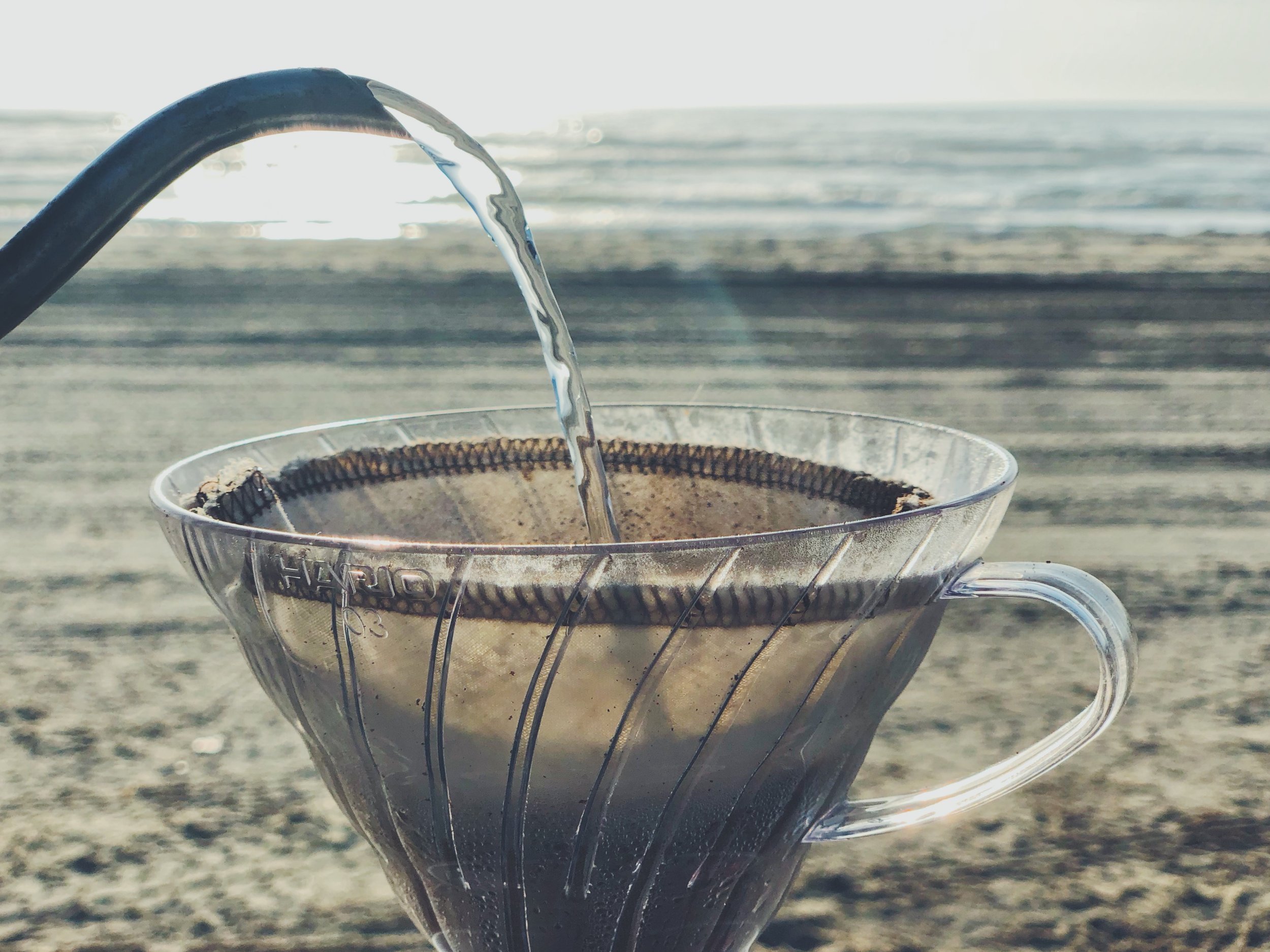
Organic cotton on the other hand is reusable and totally compostable. You’ll use your organic cotton filter for several months and when it’s time to replace it, you can put it right in the compost bin. CoffeeSock products are organic down to the thread.
Choose your filter
Check out organic cotton filters designed specifically for the HarionV60 01, 02 and 03 drippers.
How to make a better pour over coffee
Pour over coffee is simple, sustainable, portable and delicious. With a few small tweaks, you can refine your process to get it just right. Get all the details for your best cup of coffee yet.
Pour over coffee is simple, sustainable, portable and delicious. With a few small tweaks, you can refine your process to get it just right. Get all the details for your best cup of coffee yet.
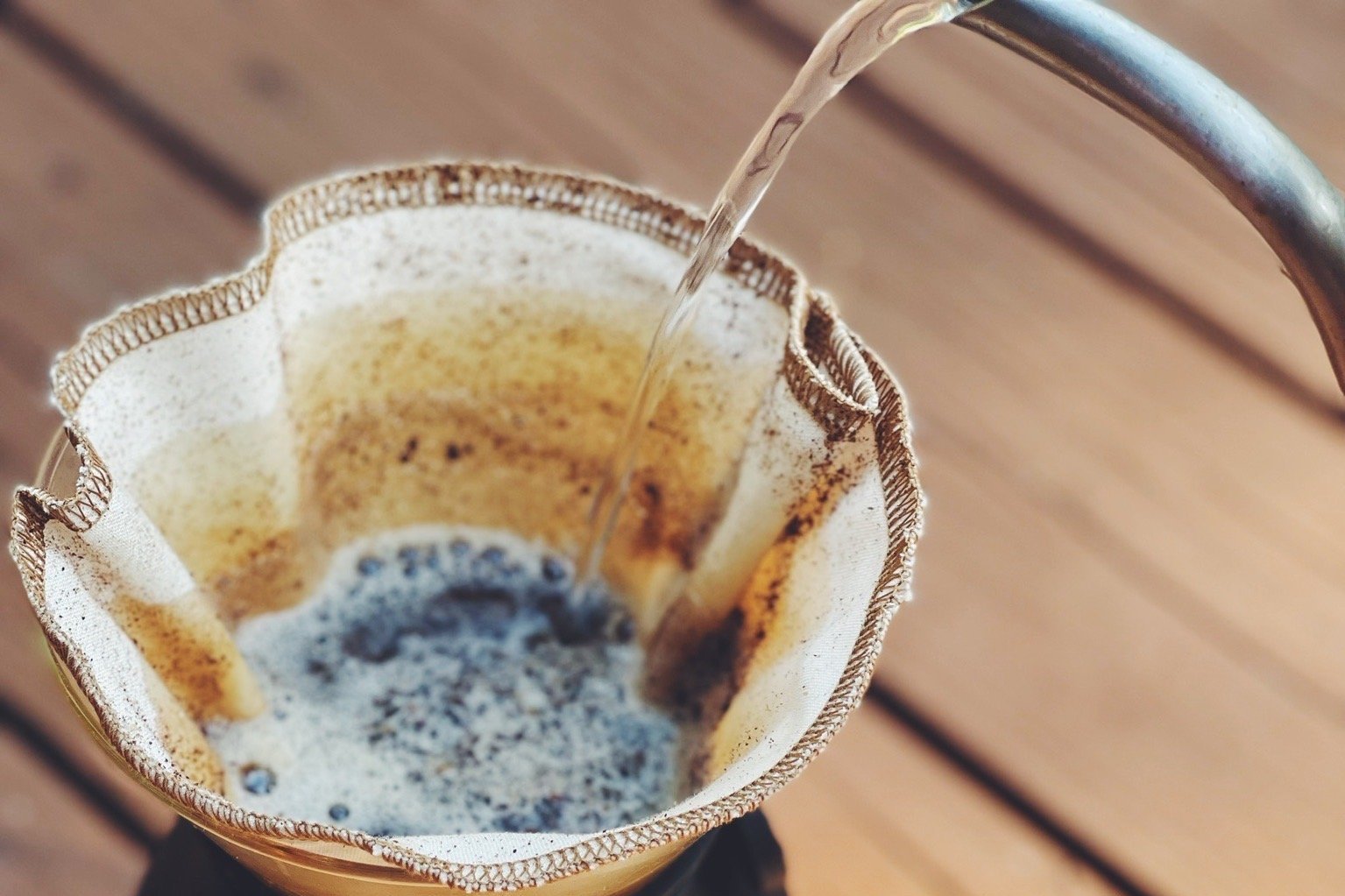
If you already make pour over coffee regularly, then you know the benefits it brings over machine-brewed coffee. If you’re new to the process and want to understand the differences between the pour over method and machine-brewed or French Press coffee, head over to our blog about the benefits of pour over.
In this article, we’ll discuss the basic elements of making a great cup or two, and help you refine those basics to get your brew just right.
Looking for a recipe? We’ve got 101 brew instructions here and a <recipe for spiced pour over here>!
Start with the basics and refine
OK, let’s jump in with the basics. To make a cup of pour over, you don’t need much.
A kettle to heat the water.
Ground coffee
A coffee filter that works for your coffee maker
Fresh water
Let’s dig a little deeper into each by answering the most-asked questions.
Can I use any kettle?
Technically you just need a kettle that can heat water, whether a stove-top kettle or an eclectic one. However, it truly helps to have a kettle with a small spout so that you can more precisely direct the flow of water.
A large spout allows a lot of water to come out all at once—which is great if you want to quickly get hot water into a cup quickly. For pour over, that is not what you want. To properly “bloom” your grounds (we explain this below), precision is better.
Choose a “gooseneck” kettle
A kettle with a long, thin spout is called a “gooseneck” kettle. It works great for pour over coffee, and works fine for all your other hot water heating needs too. It’s worth a small investment if you don’t already have one. And you can find these kettles in electric and stove top varieties.

Choose a “gooseneck” kettle
See that small opening on end? That will give you more control, allowing you to pour the water more slowly and direct it right where you want it to go.
What is the best coffee bean to use?
There are so many different flavors to play with for pour over, and no two sites agree on a “best.” The one you choose will depend on your preferred flavor profile.
Here are the basic factors to help you narrow down your favorite.
Blend or single origin?
A blend combines beans grown throughout a region or in different regions. A single-origin bean is just that—the beans come from the same region.
According to Gear Patrol, a site that deep dives into hobby gear, pour over is a great way to explore single origin flavors.
Because the pour-over technique is effective at highlighting more delicate coffee flavors, you're more likely to be able to highlight origin-specific flavor differences. Similar to how wine tasting can evoke the terroir in which it was grown, coffee takes much of its flavor from the soil it grows from. In contrast, blends take beans of different regions and combine them to create a roaster's idea of an ideal flavor profile.
In fact, our own sock papa, Robert, prefers “single origin Tarrazu, Chemex brewed.”
Of course, if you have a favorite local roaster, you might experiment with their blends and benefit from their expertise.
Light roast or dark?
On this, most sites agree. Light roast better highlights the pure flavor of the coffee bean and is better for pour over. But again, experiment with flavor profiles to get the taste that works best for you.
Pro tip: If you’re serious about finding your ideal brew, take notes! Note the origin, grind size, and roast of your coffee and how it tastes. Review your notes to figure out your favorite.
Which filter should I use?
We designed CoffeeSock filters especially for pour over coffee. The organic cotton filter results in a brighter, richer brew with just the right amount of acid. And while we started with a few basic sizes, we’ve developed socks for most brew methods.
Chemex pour over: Chemex makers come in multiple sizes. We use a six cup Chemex, but you’ll find filters for all sizes in the shop.
Small pour over drippers: For most small pour over devices that sit on a cup, you’ll use the #2 cone.
Hario v60 style has a slightly different shape. And we’ve got a filter for it. Same goes for the Kalita wave style.
Custom filters: Not finding what you’re looking for? We make custom filters too.
What is the right ratio of coffee to water for pour over?
We’ll let the experts over at Stumptown take on this one:
Using a consistent water to coffee ratio will help you with your dose. Then you can adjust for taste. As a general rule, we suggest about a 1:17, coffee to water weight ratio. In other words, for the Chemex we use 42 grams of coffee and about 700 grams of water.
This is close to the “golden ratio” you may have read about for a cup of coffee, which is 15-18 grams of water for every 1 gram of coffee. Again, play around to get your own golden cup!
Do I need a scale to weigh the coffee?
The short answer is no. You can “eyeball” your grounds and water or use a precise scoop if that’s your personality type. Some of our sockers definitely have a “devil-may-care” attitude about the golden ratio.
Of course, if you’re going for precision in your experiments, it will be easier to play around with that ratio if you can weigh your coffee and water. If you already have a kitchen scale handy, you’re in business.
Place your coffeemaker on top of the scale with the filter already in it and “tare” or zero out the scale. From there, add your coffee grounds to correct weight for the amount of coffee you’ll make and then keep on the scale as you add water. Stupmtown gives you a great starter weight for a single cup of coffee brewed with a Chemex.
How fine should I grind the coffee?
For this, you’ll want to do a little research to find out the right grind size for the coffee maker you’re using. As a general rule, you want a medium grind for pour over. Your grounds should look like table salt. Not a powder and not large sea-salt like pieces. But clearly defined individual grounds.
Some coffee makers will use a slightly smaller or larger size grind for an optimal cup. But a medium ground works for most pour over methods. And home-ground, fresh coffee is best. But if you don’t have a grinder and don’t want to invest, ask a barista at your local shop to grind it for you if you can.
Should I use boiling water?
You’ll want to bring your water to a boil and then give it a few seconds “off the boil.” Your water should be between 200-210 degrees when you pour it.
To start your pour over coffee, bloom the grounds
The “bloom” is your first pour. It allows the coffee to fully degas. Don’t skip the bloom! This method ensures that you get your grounds evenly wet and have a full flavor and even brew.
To bloom your coffee, pour the hot water slowly over the grounds in a spiral, starting at the outside and working your way to the middle. Make sure you get everything wet, then let the grounds sit for about 30 seconds.
You should see some slightly bubbling and rising action.
After 30 seconds, use the same even, slow spiral method to finish pouring the water.
Put it all together, step-by-step
To make your ideal pour over:
Rinse and wet your coffee filter and place it in your coffee maker
Place the coffee maker with the filter in it on a kitchen scale and zero it
Grind your coffee, if doing so at home
Measure out your coffee at about 42 gram per cup
Bloom the grounds with hot water (about 205 degrees) and let sit for 30 seconds
Finish pouring the hot water in slow spirals until you have the right amount of water, about 700 grams per cup.
Pour into your mugs and enjoy
Our family chess games last a week, and I've never loved chess more
We cannot always be home and together. Through an ongoing game of chess, we stay connected, even when we’re apart.
We cannot always be home and together. Through an ongoing game of chess, we stay connected, even when we’re apart.

In the fall of 2020, we were homebound when the wildly popular series The Queen’s Gambit gifted our family with a chess craze. In fact, so many people took up the game that chess sets (the affordable ones) sold out globally, probably the least predicted shortage of the pandemic.
We played together, at length. Chess champions may play short games, but for a group of novices, the games could take hours. And hours, in the fall of 2020, we had.
Our opening move
In the hyper-modern, screen-focused world on lockdown, chess was a true gift. An ancient and immersive game, it met some of our deepest needs during the pandemic, beyond mere survival. It gave our worn out and stressed brains something new, with simple rules, elaborate strategies, and a new language.
We set up a board on a corner of our dining table, and learned the unique talents and vulnerabilities of bishops, knights, pawns and rooks. We snuck off to study brazen openings and sneak attacks. We played in pairs and in teams, though I don’t think that’s regulation.
For a while, we stretched a long-dormant muscle—focused and sustained attention.
Until we couldn’t. Or didn’t. In came 2021 and, eventually, out went lockdown. In-person school returned and soon thereafter, homework and sports clubs and occasional meetups. Time became scarce again, and out went most things long, sustained, slow, leisurely and nonproductive.
The family gambit
But we didn’t put away the board.
We moved it. It got dusty. The cat knocked over the pieces, and the dog carried them away. But the board stayed out and opened. And every so often, one of us would dust it off, recover the scattered pawns, and make an opening.
A chess board, all set up with one opening move, is an invitation. If it sits there long enough, someone will respond.
A day or two passed, and a second move appeared. Another few hours and there was a third. Within a week, we had a full-blown game in progress. We didn’t know who made each move. It’s entirely possible that someone played themselves. And it didn’t matter. The competition wasn’t the point.
Each new move that appeared on the board was a small gift of time and care. It meant that someone else had stopped in the midst of whatever else they were doing and engaged with this shared experience. It meant that the game, the experience, the connection had value. It meant we craved presence, even when we were apart.
No endgame
As 2021 comes to a close, we’ve played through many week-long (month-long?) chess games. Each one is a victory for us—a little celebration of connection and a rebellion against the short-attention-span world.
I don’t know how long these epic chess games will last. I know that someday, I will probably close the board and put away the pieces. And when that day comes, I will thank every single one of those little avatars for reminding me every time they showed up on a new square, that I am loved.
The joy of small, meaningful efforts
What if some of the most important lessons we learned during the pandemic can actually improve our holidays, our everyday lives, our communities, and the planet? What if small, meaningful, collective efforts can bring us joy? When friends, families, and communities make small efforts together, the rewards multiply—for our health, our budgets, and the environment.
When friends, families, and communities make small efforts together, the rewards multiply—for our health, our budgets, and the environment.
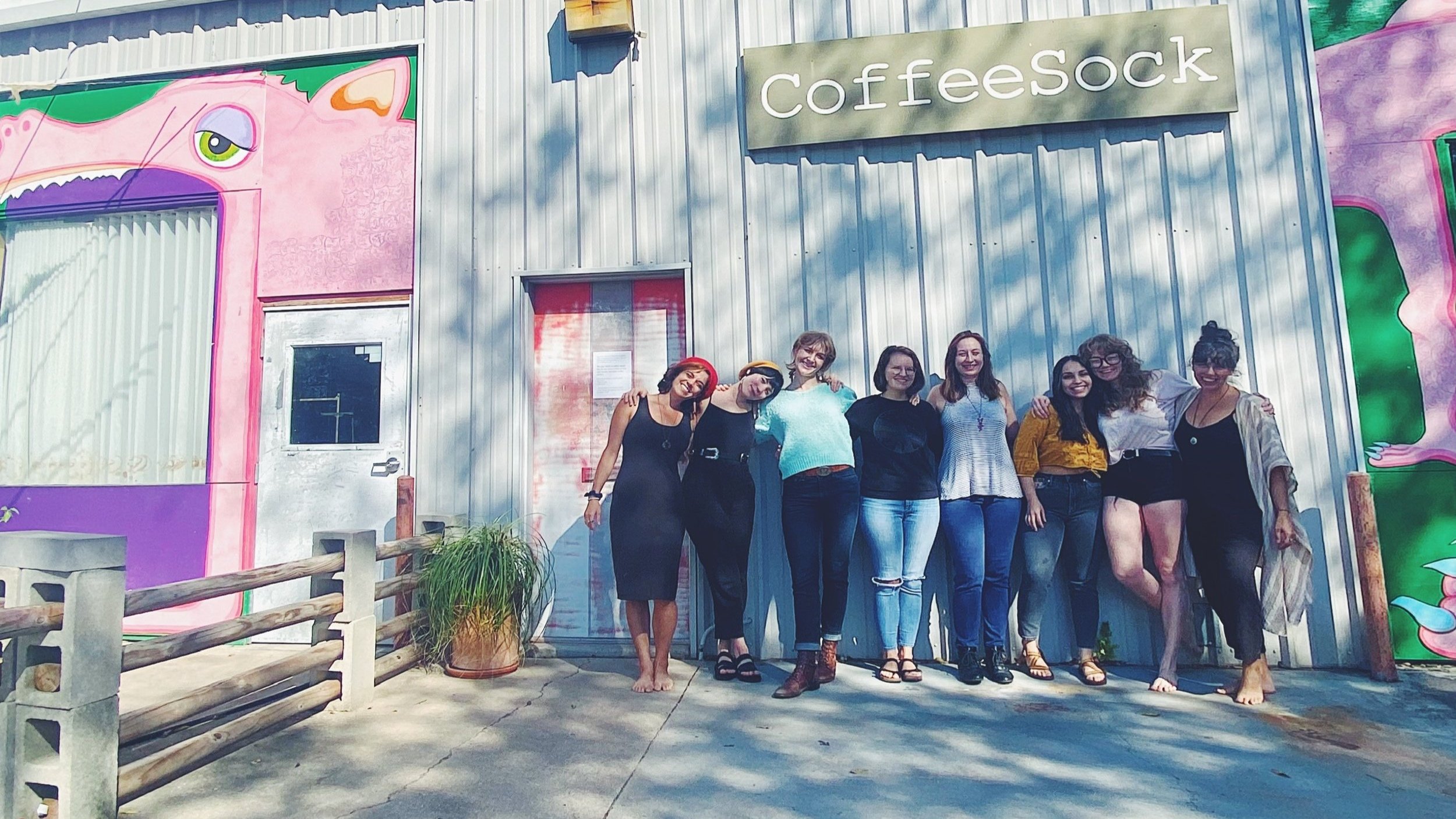
I don’t know about you, but we’ve been hearing mixed messages and having mixed feelings this holiday season.
Feel safe gathering with friends and family again! (But travel is still a little scary.) Feel free to shop! (But everything is more expensive or missing from store shelves. And for many of us, the photos of cargo ships idling in the ocean is really making us think twice about what we buy and where it’s from. ) The economy is recovering! (But the traffic is creeping back into our lives and emissions are at pre-pandemic levels.)
If things are getting back to normal, are we good with that?
What if some of the most important lessons we learned during the pandemic can actually improve our holidays, our everyday lives, our communities, and the planet? What if small, meaningful, collective efforts can bring us joy?
How effort causes joy
You’re probably experienced it—a sense of accomplishment or pride, or a rush of endorphins or pure joy when you’ve managed a challenging task.
I recently received a FREE treadmill from my neighborhood Buy Nothing list, and I vowed to walk or run at least five days per week. I don’t always want to do it. But every single time, about halfway through, I am proud of myself and feeling pretty great.
And this phenomenon extends beyond physical challenges. Studies show that meeting challenges through personal effort can make you feel more confident, stronger, and happier in the long run, even when the effort isn’t joyful in the short run. It’s true in academic accomplishments, in exercise, in building things, growing things, cooking, cleaning, making and more.
Community efforts you can take this season (and the joy they bring)
Small shopping & gift giving tweaks
According to the Wall Street Journal, “Buy Nothing” neighborhood groups “added two million members between March 2020 and October 2021.” Part of the allure was necessity—with millions out of jobs, communities came together to help one another with food, clothing, and the goods of everyday life.
But part of the allure was the community itself, and not all Buy Nothing exchanges were for goods. Many people gave gifts of service, do grocery shopping trips for those who couldn’t get out or rewrite resumes for those seeking a job.
This holiday season, we can take a note from the values of Buy Nothing and bring that sense of community into our holiday celebrations.
A few ideas:
Buy locally-made. No shipping container necessary for products that are made locally. And you’ll be supporting your neighbors.
Buy less, or nothing at all. Know a loved one who has worn out their favorite sweater, boots, or bag? Try mending or sending them out for repair. Or offer up toys and other items in good repair to your Buy Nothing group and take advantage of a book or piece of art that someone you love would enjoy.
Pay attention to Love Languages. Thoughtfully purchased gifts can be perfect. But for some of the people closest to you, they may prefer acts of service or words of affirmation. Consider having your loved ones take the love language quiz. Use their results to offer handwritten letters, a clean house, a massage, or a one-on-one hiking trip.
Buy secondhand or reusable. I don’t know about you, but I’ve found some of my favorite articles of clothing at vintage, secondhand, and thrift shops. You can make an adventure out of it, taking friends, family, or kids to the thrift shop on a mission to uncover the hidden treasures.
Small food tweaks
Eating and drinking is one of the biggest pleasures of the holidays, for kids and adults alike. During the pandemic, we came face-to-face with food shortages, the need to cook at home, and the missed pleaser of eating with friends. With a few small tips from the past two years, you can increase the joy of party food while benefiting your wallet, your waist, and the planet.
A few ideas:
Expand your side dish offerings. On the holiday table, side dishes are where we typically find the veggies. And eating more veggies costs less, is healthier, and is better for the planet. Check out these yummies and these for inspiration.
Eat more and waste less. We are big fans of making our own stock, which you can do with all the things you trim from your side dish veggies! And this year, we plan to make dumplings with leftovers after taking this dumpling-making class from the Li sisters of Food Waste Feast. And what we don’t use up, we’ll compost. https://coffeesock.com/the-sock-life-1/2021/5/23/three-simple-ways-to-compost-at-home az
Try the gift of foraging. If you’re one of the millions who watched the Netflix documentary Fantastic Fungi, then maybe you’ve already started noticing the mushrooms poking out of the ground around you. Of course, you don’t want to toss them in your mouth without knowing they’re safe. That’s where a guide comes in. Consider a foraging adventure as a gift or alternative to an indoor party. Hire a guide or take a course, and get to know the bounty of mushrooms, berries, nuts, fruits, and other edibles that grow right from the ground around you.
Small transportation tweaks
The parties, the family gatherings, the happy hours and events! Travel seems like an inevitable part of the holidays. During the pandemic, we saw clear (literally) benefits from driving less. Many people saved time from not commuting, and virtually everyone experienced cleaner air from…people not commuting. And being outside instead of confined spaces, like cars, was safer. With a small amount of effort, you and your crew can even make the travel part your events!
If it’s possible for you, walk or bike. With a little planning, you may be able to map out a route to your celebration by foot or by bike. And if it’s in the budget and makes sense for your commute, electric bikes are showing up more and more as a mode of transportation that’s much cheaper than a car and much better for the environment and the waistline. Even better? Build the walk or bike into the celebration’s agenda!
If it’s possible for you, swap out public transport. If you have a bus or rail option, now may be a good time to see if it can work for you. Yes, it takes more planning. But it can also be part of your holiday adventure. And experience on public transit can be an excellent part of learning independence and safety for kids.
Try carpool, or even car repair. CoffeeSock is in Texas, so yes we drive cars regularly and have fewer public transport options than we wish we had. To offset our driving, we arrange carpools when possible and keep our tires aired up properly and our car in good working order. You can read more about the impact of car maintenance here.
Small things, often.
Have you heard of The Gottman Institute? Drs John and Julie Gottman have been teaching relationship skills for couples and parents for more than 40 years. And what does this have to do with small community efforts? A lot, actually.
One of the key principles of relationships, according to the Gottmans, is making regular small efforts. It’s even the title of their podcast!
And when we think about our relationships with our communities, our families, our own selves and yes, our significant others and children, the same ideas apply. Small efforts, done often, create lasting change and bring joy.
What small effort will you make today?